 |
|
| sea anemones text index | photo index |
| Phylum Cnidaria > Class Anthozoa > Subclass Zoantharia/Hexacorallia > Order Actiniaria |
| Frilly
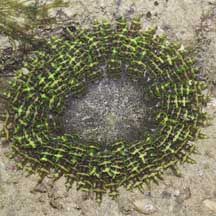
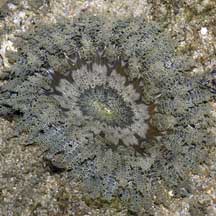
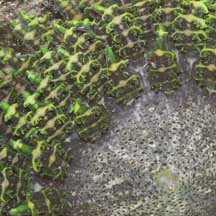
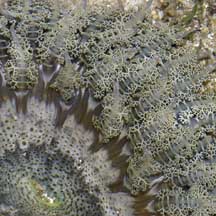
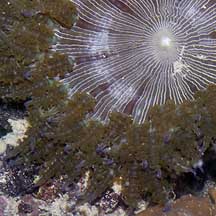
anemones Phymanthus sp.* Family Phymantidae updated Dec 2024 Where seen? These anemones with many fine 'branches' on their tentacles are often seen on many of our shores. Among coral rubble, usually with the body column wedged in crevices. Features: Diameter with tentacles expanded 8-12cm. Tentacles about 3-5cm long with elaborate 'branches'. Only one side of the tentacle appears to bear the 'branches'. The anemones come in a wide variety of colours and their branched tentacles may have different patterns. Also sometimes encountered are branched anemones with tentacles that are generally smooth with only slight bumps. The body column is pale becoming darker near the top and has longitudinal rows of white verrucae. The anemone can tuck its tentacles into its body column. Sometimes mistaken for other feathery animals. Here's more on how to tell apart feathery animals on our shores. Status and threats: As at 2024, it is assessed not to be approaching the criteria for being listed among the threatened animals in Singapore. |
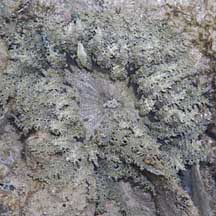 Beting Bemban Besar, May 11 |
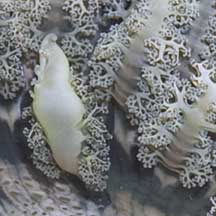 Only one side of the tentacle bears 'branches'. |
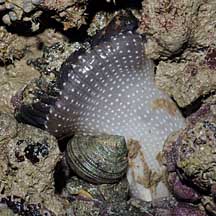 Body column pale becoming darker near the top with rows of white spots. Pulau Semakau, Apr 08 |
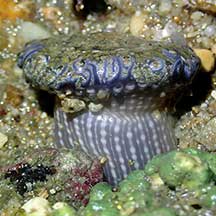
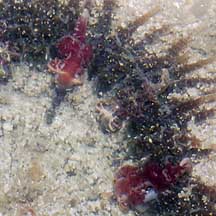
| Frilly friends: The Frilly anemone harbours symbiotic algae (called zooxanthellae) that undergo photosynthesis to produce food. The algae share this food with the anemone, which in turn provides the algae with shelter and minerals. A pair of Peacock-tail anemone shrimps were seen once in a Frilly anemone. |
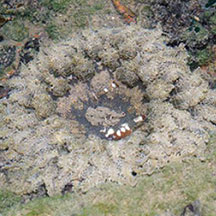 A pair of Peacock-tail anemone shrimps seen in this anemone. Tanah Merah, May 13 Photo shared by Loh Kok Sheng on flickr. |
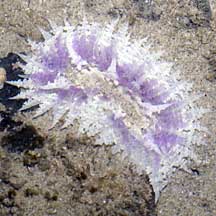 Bleaching frilly anemone Cyrene Reef, Jul 10 |
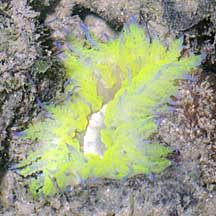 Bleaching frilly anemone Cyrene Reef, Aug 10 |
| Some Frilly anemones on Singapore shores |
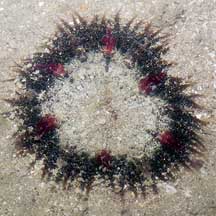 |
 |
 |
 |
 |
 |
|
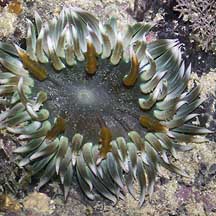
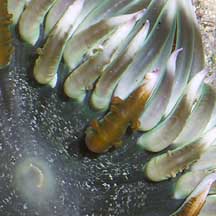
Six
of the tentacles usually of a different colour.
|
Tentacles
with bands.
|
Tentacles
uniformly coloured 'branches' may be outlined in white.
|
 |
 |
|
 |
 |
|
|
Tentacles
smooth, but with small branches visible.
|
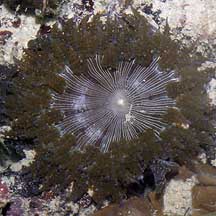
Mouth
with fine white lines radiating from the centre.
Tentacles with violet tips. |
*Species
are difficult to positively identify without close examination.
On this website, they are grouped by external features for convenience
of display
Links
|