cnidarians text index | photo index
Phylum Cnidaria
Animals with a ring of smooth tentacles
How to tell them apart?
updated Aug 08

Several animals with a central mouth surrounded by a ring of smooth tentacles are sometimes confused for one another. Here's more on how to tell them apart.

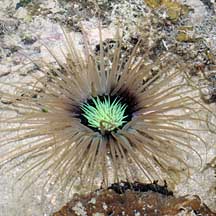
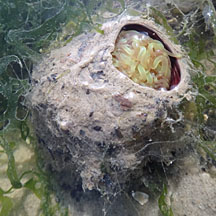
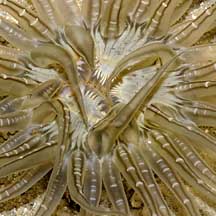
Cerianthids
Order Ceriantharia
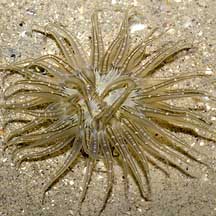
True sea anemones
Order Actiniaria
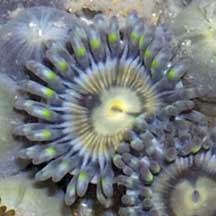
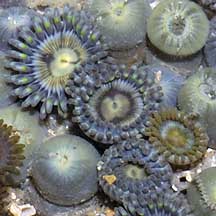
Zoanthids
Order Zoanthidae
Usually found alone. Usually found alone. Usually found in groups of many individual polyps. The polyps are joined to one another.
An outer ring of longer tentacles and an inner ring of much shorter tentacles. Various arrangement of tentacles. Tentacles may be long or short. Two rows of tentacles. Tentacles usually very short and of equal length.
Lives inside a soft tube that it creates. Does not live inside a tube. Does not live inside a tube.

More comparisons


The shy glass cerianthid
has transparent tentacles.

Haddon's carpet anemone
has short tentacles.

The Carpet corallimorph has longer
tentacles than other corallimorphs.


Here are two kinds of zoanthids, bigger brown
ones among smaller blue ones.

Banded bead anemones are true
sea anemones although found in a group.

The Beaded corallimorph has bumps.


The Wriggly star anemone is a true
sea anemone with few tentacles.

The Snaky anemone is a true sea anemone
with many long tentacles.

The Bulb tip anemone is a true sea anemone
with many tentacles with bulbous tips.


The Sunflower mushroom coral
is a hard coral and not a true sea anemone.

The Anemone hard coral
is a hard coral and not a true sea anemone.

The Anchor coral
is a hard coral and not a true sea anemone.

how to tell apart
www.flickr.com
FREE photos of cnidarians. Make your own badge here.
links | references | about | email Ria
Spot errors? Have a question? Want to share your sightings? email Ria I'll be glad to hear from you!
wildfactsheets website©ria tan 2008