Fish
farming and aquaculture
updated
Jan 10
if
you learn only 3 things about the issue...
Commercial fish farms can impact the surrounding habitats.
Find out where your fishes come from.
Eat
less fish, don't throw fishes away. |
|
Fish farms in Singapore
Singapore's
consumption of fish is estimated to be 100,000 tonnes per year of
which about 5% is accounted for by local foodfish aquaculture. This
is mainly from coastal fish farms. They produce marine foodfish
species like groupers, seabass, snappers and milkfish as well as
green mussels and crustacean (shrimp/mangrove crabs). There are
also freshwater foodfish farms producing snakeheads, tilapia, catfishes
and carps and other cyprinids. From
Aquaculture
in Singapore on the AVA website
In 2010, there were 106 licensed coastal floating fish farms in
Singapore, producing 3,235 tonnes of fish valued at $11.4 million
in 2008. They accounted for 4-5% of the fish consumed annually in
Singapore. From Plankton
bloom hits Pulau Ubin fish farms Melissa Sim, Straits Times
2 Jan 10;
Why
farm fishes?
Some broad goals of acquaculture
- Reduce costs
of searching, catching and transporting fish.
- Stable
and predictable supply of fish. Not necessarily achieved as mass
deaths of stock can occur.
- Reduce overharvesting
of wild fishes. Not necessarily achieved as wild fishes are still
caught, to feed the farm fishes.
Some
effects of acquaculture
- Parasites
and diseases from farmed fish can spread to wild marine life.
- Pollution
of the surrounding waters by the following that escape from fish
farms:
- Drugs,
including antibiotics, given to farmed fish to keep them healthy.
- Excess
and uneaten food given to farmed fish.
- Wastes
of farmed fish.
- Non-native
farm fishes which escape can threaten native wild fish.
- Farmed fish
are fed pellets made from other fish, depleting other fish species
on a global scale. Often the small fishes which are daily staples
of poor people are used as feed for larger farmed fishes which
are sold as luxury items.
- Setting up
and running fish farms can physically impact the surrounding habitat.
What
are some features of sustainable acquaculture?
"Ecologically
integrated into the agricultural, industrial, and community fabric,
meaning, for example, that wastes become fertilizers rather than pollutants.
Additionally, these species are herbivores, so other fish species
are not used in their production" From Aquaculture
on the David Suzuki Foundation website.
What
can we do about this?
- Find out
where your fish comes from.
- Tell your
supplier and supermarket you prefer fish from sustainable sources.
- Eat less
fish.
- Eat what
you take. Don't throw away fishes! (or any food for that matter).
Many marine animals have died and people have suffered to put
that fish on your plate!
See
also impact of prawn farming.
|
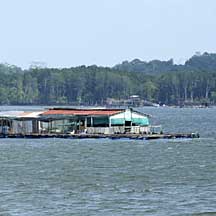
Fish farm off
Lazarus and St. John's Island.
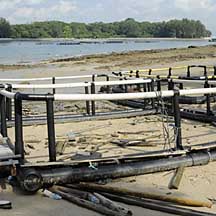
Fish farm equipment
'parked' on
Lazarus island shore.
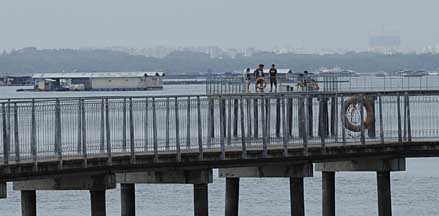
Fish farm off
waters of Pasir Ris and Pulau Ubin.
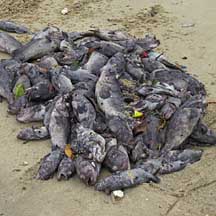
Mass death of
farm fishes
Pasir Ris, Dec 09
|