 |
|
|
Elbow
crabs
Family Parthenopidae
updated
Aug 10
if you
learn only 3 things about them ...
They are tiny well camouflaged crabs. That's why we should
avoid stepping areas thick with seaweeds and seagrasses.
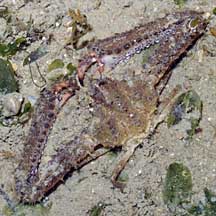
Their 'elbows' are often much longer than their bodies!
To
see one, look carefully at every bit of 'rubbish'. |
|
Where
seen?
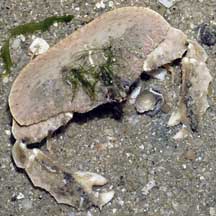
These tiny, slow-moving crabs look like bits of dirt or junk among
seaweeds. Look very carefully to find them. Elbow crabs are commonly
seen on our Northern shores, among seagrasses and seaweeds.
Features: Body width 1-2cm. An
obvious feature of the elbow crab (once you can actually see the crab)
is its highly elongated pincers that stick way out from the sides
of its body. The upper finger is moveable and curved towards the immobile
lower finger. Males may have larger pincers than females. The thin
walking legs are small and have pointed tips. Body somewhat triangular
or pentangonal. The crab's body and claws may be fuzzy or bumpy and
coloured the same as mud or sand. Some have fluffy algae or even tubeworms
growing on the body and arms.
The pincers are large, relative to the crab, and look like they can
do some serious damage to small prey. The inner surface of the claws
have a row of coloured bumps and spots that are probably used to startle
predators.
Elbow crab food: The elbow crab
eats worms and small snails and clams.
Role in the habitat: Elbow crabs
are predators of small creatures. In turn, they are eaten by many
animals higher up in the food chain. Some small species live on soft
corals and sea urchins.
Status and threats: Some of our
elbow crabs are listed among the threatened animals of Singapore.
Like other creatures of the intertidal zone, they are affected by
human activities such as reclamation and pollution. Trampling by careless
visitors also have an impact on local populations. |
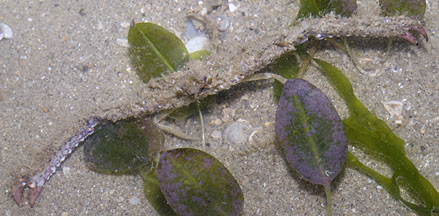
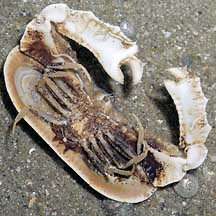
Pincers
many times longer than its body.
Changi, May 06

Bumps on the inner pincer.
|

Pulau
Sekudu, Jun 05
|

Mama
crab with egg mass on her abdomen.
|

Small
eyes.
|
Elbow
crabs on Singapore shores

Chek Jawa, Mar 03
|
|
|

Changi,
Jul 07
|
|
|

Changi,
Aug 09
|
|
|
Family
Parthenopidae recorded for Singapore
from
Wee Y.C. and Peter K. L. Ng. 1994. A First Look at Biodiversity
in Singapore
in red are those listed among the threatened
animals of Singapore from Davison, G.W. H. and P. K. L. Ng
and Ho Hua Chew, 2008. The Singapore Red Data Book: Threatened
plants and animals of Singapore.
| |
Aulacolambrus
granulosus (CR: Critically endangered)
Aulocalambrus hoplonotus
Aulocalambrus planifrons
Banareia armata
Banareia subglobosa
Cryptopodia fornicata
(Domed
elbow crab) (EN: Endangered)
Cryptopodia laevimana
Daldorfia
horrida (NE: Presumed Nationally Extinct)
Parthenope lippus
Parthenope longimanus (Caltrop
elbow crab)
Parthenope tumidus
Parthenope carinatus
Parthenope echinatus
Parthenope prensor
Parthenope validus
Platylambrus
echinatus (EN: Endangered)
Pseudolambrus
bicornis
(Two
horned elbow-crab)
(CR: Critically endangered)
Rhinolambrus contrarius
Rhinolambrus deflexifrons
Rhinolambrus latifrons
Rhinolambrus longispinis
Rhinolambrus pelagicus (VU: Vulnerable) |
|
|
Links
References
- Ng, Peter
K. L. and Daniele Guinot and Peter J. F. Davie, 2008. Systema
Brachyurorum: Part 1. An annotated checklist of extant Brachyuran
crabs of the world. The Raffles Bulletin of Zoology. Supplement
No. 17, 31 Jan 2008. 286 pp. (Online
PDF on the Raffles Bulletin of Zoology website).
- Lim, S.,
P. Ng, L. Tan, & W. Y. Chin, 1994. Rhythm of the Sea: The Life
and Times of Labrador Beach. Division of Biology, School of
Science, Nanyang Technological University & Department of Zoology,
the National University of Singapore. 160 pp.
- Davison,
G.W. H. and P. K. L. Ng and Ho Hua Chew, 2008. The Singapore
Red Data Book: Threatened plants and animals of Singapore.
Nature Society (Singapore). 285 pp.
- Wee Y.C.
and Peter K. L. Ng. 1994. A First Look at Biodiversity in Singapore.
National Council on the Environment. 163pp.
- Jones Diana
S. and Gary J. Morgan, 2002. A Field Guide to Crustaceans of
Australian Waters. Reed New Holland. 224 pp.
|
|
|