Piluminid
crabs
Family Pilumnidae
updated
Dec 2019
Where
seen? The most commonly seen member of this family on our
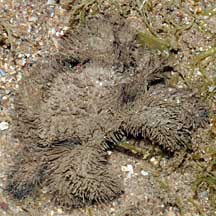
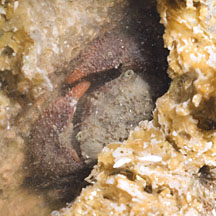
shores are the Common hairy crabs (Pilumnus sp.) near rubble and reefs.
Features: Not all pilumnid crabs
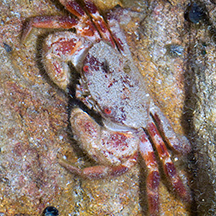
are hairy. They come in a wide variety of shapes and features and
some are difficult to tell apart.
Status and threats: Several members
of the Famil Pilumnidae are listed among the threatened animals of
Singapore. Like other creatures of the intertidal zone, they are affected by
human activities such as reclamation and pollution. Trampling by careless
visitors also have an impact on local populations. |
| Some Hairy
crabs on Singapore shores |
Family
Pilumnidae recorded for Singapore
from
Wee Y.C. and Peter K. L. Ng. 1994. A First Look at Biodiversity
in Singapore
in red are those listed among the threatened
animals of Singapore Davison, G.W. H. and P. K. L. Ng and
Ho Hua Chew, 2008. The Singapore Red Data Book: Threatened plants
and animals of Singapore.
+from The Biodiversity of Singapore, Lee Kong Chian Natural History Museum.
**from WORMS
| |
Actumnus
asper
Actumnus elegans
Actumnus setifer (Rubble-carrying
hairy crab)
+Actumnus aff. squamosus
Bathypilumnus sinensis
+Benthopanope eucratoides
+Benthopanope aff. eucratoides
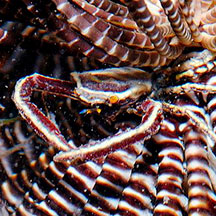
Ceratocarcinus longimanus (Feather star crab)
Ceratoplax ciliata
Galene bispinosa (**Now in Family Galenidae)
Glabropilumnus edamensis
(VU: Vulnerable)
Gonatonotus pentagonus (EN:
Endangered)
Halimede ochtodes (**Now in Family Galenidae)
Harrovia albolineata (Feather star crab) (CR: Critically endangered)
Harrovia longipes (Feather star crab) (CR:
Critically endangered)
Heteropanope changensis
Heteropanope glabra
Heteropilumnus hirsutior
Heteropilumnus holthuisi
+Heteropilumnus sasekumari
Heteropilumnus splendidus
+Leelumnus radium
Mertonia lanka
(VU: Vulnerable)
+Nanopilumnus heterodon
Parapanope euagora (EN:
Endangered) (**Now in Family Galenidae)
Pilumnopeus eucratoides=**Benthopanope eucratoides
Pilumnus barbatus=**Nanopilumnus barbatus
+Pilumnus aff. cursor
Pilumnus edamensis=**Glabropilumnus edamensis
Pilumnus kasijani
Pilumnus labyrinthicus=**Vellumnus labyrinthicus
Pilumnus laevimanus=**Glabropilumnus laevimanus
Pilumnus laevis=**Glabropilumnus laevis
Pilumnus longicornis
Pilumnus minutus
Pilumnus murphyi (VU:
Vulnerable)
Pilumnus neglectus
Pilumnus ohshimai (EN:
Endangered)
Pilumnus penicillatus=**Vellumnus penicillatus
+Pilumnus cf. ransoni
Pilumnus rouxi
Pilumnus rufopunctata
Pilumnus scabriusculus
+Pilumnus serenei
+Pilumnus sluiteri (Fuzzy reef crab)
Pilumnus spinifrons
Pilumnus vespertilio (Common hairy crab)
Pronotonyx laevis
Vellumnus labyrinthicus (VU:
Vulnerable)
Rhizopa gracilipes
+Rhizopinae sp.
Rhizopoides yangae (EN:
Endangered)
Typhlocarcinus nudus
Typhlocarcinus villosus
+Vellumnus labyrinthicus
Zebrida adamsii (EN:
Endangered) |
|
Links
References
- Tan Heok Hui. 16 May 2014. Horned crinoid crab in the Singapore Straits, Ceratocarcinus longimanus. Singapore Biodiversity Records 2014: 132.
- Lee BY & Ng NK (2012) New record of the mangrove crab, Heteropilumnus sasekumari (Serene, 1971) (Crustacea: Brachyura: Pilumnidae) from Singapore. Nature in Singapore, 5: 57–59.
- Tan HH (2012) A recent Singapore record of the crinoid crab, Harrovia longipes Lanchester (Crustacea: Brachyura: Pilumnidae). Nature in Singapore, 5: 237–240
- Jose Christopher E. Mendoza, Peter K. L. Ng. Leelumnus radium, a new genus and species of pilumnid crab from marine encrusting communities in Singapore (Crustacea: Decapoda: Brachyura: Pilumnidae). 5 Apr. 2011. Zootaxa Vol 2809, No 1.
- Chou, L.
M., 1998. A Guide to the Coral Reef Life of Singapore.
Singapore Science Centre. 128 pages.
- Lim, S.,
P. Ng, L. Tan, & W. Y. Chin, 1994. Rhythm of the Sea: The Life
and Times of Labrador Beach. Division of Biology, School of
Science, Nanyang Technological University & Department of Zoology,
the National University of Singapore. 160 pp.
- Davison,
G.W. H. and P. K. L. Ng and Ho Hua Chew, 2008. The Singapore
Red Data Book: Threatened plants and animals of Singapore.
Nature Society (Singapore). 285 pp.
- Wee Y.C.
and Peter K. L. Ng. 1994. A First Look at Biodiversity in Singapore.
National Council on the Environment. 163pp.
- Jones Diana
S. and Gary J. Morgan, 2002. A Field Guide to Crustaceans of
Australian Waters. Reed New Holland. 224 pp.
|
|
|