 |
|
|
plants text index | photo
index
|
| coastal plants |
| Kuku
tupai Caesalpinia crista Family Fabacea updated Jan 2013 Where seen? This prickly climber is sometimes seen growing wild along the seashore and back mangroves. 'Kuku tupai' means 'squirrel's claws' in Malay and aptly describes an encounter with this climber. The small but sharp thorns on the long, strong stems often catch on clothing and skin. Getting entangled in a thicket of this climber can be rather unpleasant and makes you feel ike you're being attacked by angry little squirrels! According to Hsuan Keng, it was found on sandy beaches and fringes of mangroves at Kranji and Jurong. It was previously known as C. nuga. Features: A climber (5-20m long) that can scramble over tall trees. The plant is armed with tiny little thorns which are often black on a long, strong usually green stem. Young stems are red turning green. The compound leaf is bipinnate, i.e., resembles a feather, with leaflets arranged on side branches on a main leaf branch. Leaflets eye-shaped, rather leathery, stiff, smooth and shiny. The entire compound leaf 10-30cm long. Flowers small (2cm) in a cluster (20-40cm long), scented, showy bright yellow with orange accents, white woolly stamen stems. The flowers appear to attract a wide variety of bees during the daytime. The fruits (4-7cm long) are flat smooth pods (not prickly) with a beak which contain a large black seed. Green ripening to black. Sometimes mistaken for Maiden's jealousy (Tristellateia australasiae) especially when in bloom. Human uses: According to Giesen, the seeds are used to treat malaria and parasitic worms. The leaves are used to treat Hepatitis A. The seeds are also used by children as marbles. Status and threats: This tree is listed as 'Vulnerable' in the Red List of threatened plants of Singapore. |
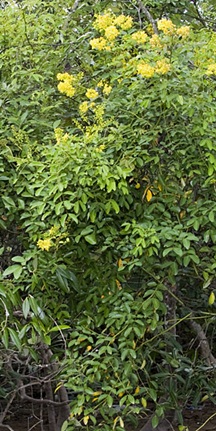 Kranji Nature Trail, Mar 11 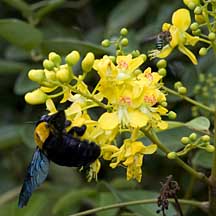 Kranji Nature Trail, Feb 11 |
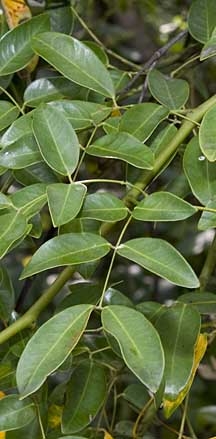 Leaf is bipinnate. Kranji Nature Trail, Mar 11 |
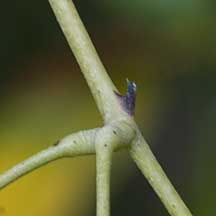 Black thorns on green stems. 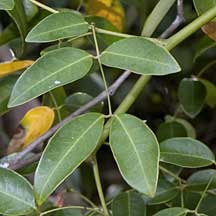 Kranji Nature Trail, Mar 11 |
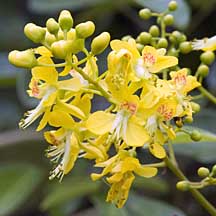 Kranji Nature Trail, Feb 11 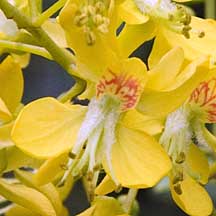 |
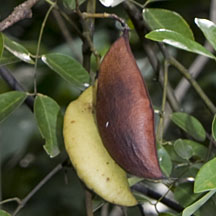 Sungei Buloh Wetland Reserve, Mar 11 |
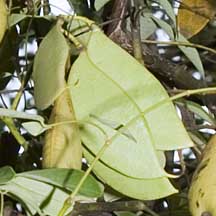 Kranji Nature Trail, Feb 11 |
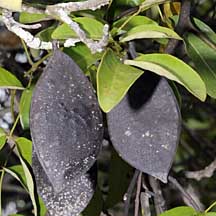 Pulau Ubin, Nov 09 |
| Kuku tupai on Singapore shores |
| Photos of Kuku tupai for free download from wildsingapore flickr |
| Distribution in Singapore on this wildsingapore flickr map |
|
Links
References
|
|
|