 |
|
|
plants text index | photo
index
|
| coastal plants |
| Rambut
putri Cassytha filiformis Family Lauraceae updated Jan 13 Where seen? This long hair-like plant is often seen draped in green or golden tangles on seaside shrubs and small trees. 'Rambut putri' means 'Hair of the Princess' in Malay. According to Giesen, It can sometimes smother the host so densely that the latter is scarcely visible. More rarely seen inland, for example in dwarf swamp forests. It is found on all tropical shores and common throughout Southeast Asia. Sometimes recognised as a separate family, the Cassythaceae. According to Hsuan Keng, it is common in open bushes by the sea including Changi. Features: A semi-parasitic plant, it has long stems (3-8m) that grows in a tangle on host plants, green or yellow. The thin smooth stems do not root, they attach to the host by suckers. They are hollow, cylindrical and dark green to reddish-or yellowish-brown. It latches onto a wide variety of hosts (some describe it as being "totally indiscriminate in host choice"), relying on the host for physical support, water and nutrients. There are no visible leaves. The flowers are tiny (1.5-2mm) held on a short stalk. Fruits are small, round, juicy white berries (7mm) that are eaten and dispersed by birds. Cuscuta australis looks similar and is also a semi-parasite. But it has flowers in a globular cluster (not on a stalk) and it tends to scramble on the ground. While Cassytha filiformis seems to prefer woody hosts and so tends to drape on taller shrubs and trees. Human uses: According to Burkill, the dried, powdered stems are used in hair tonic. While it may not do any good, the use is possibly because the plant is hair-like and luxuriant. In India, it is used in cleaning ulcers and in an eye-wash. In Java, the pounded stems are used for intestinal ailments. According to Giersen, the plant is sometimes cultivated for its medicinal uses in parts of Indonesia. |
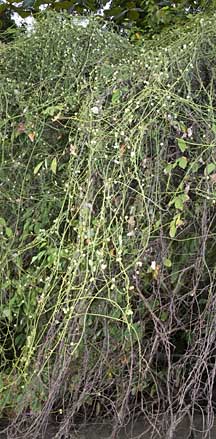 Lazarus Island, Feb 11 |
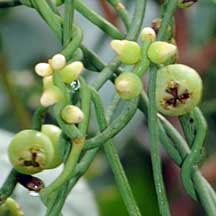 Tiny flowers on short stalk. Pulau Semakau, Dec 08 |
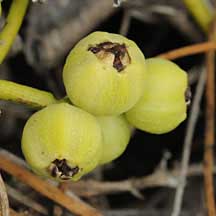 Small globular berries. Pulau Semakau, Apr 09 |
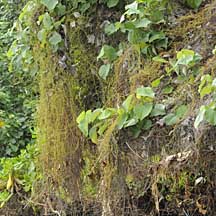 Pulau Hantu, Apr 09 |
Rambut putri on Singapore shores
| Photos for free download from wildsingapore flickr |
|
Links
References
|
 .
Singapore University Press. 222 pp.
.
Singapore University Press. 222 pp.|
|