 |
|
|
plants
text index | photo
index
|
| coastal plants |
| Seashore
bat lily Tacca leontopetaloides Family Taccaceae updated Jan 13 Where seen? A very rare plant in Singapore, it now only occurs naturally at Pulau Semakau and Pulau Pawai. Some propagated plants can be found at Bukit Batok Park. It grows in the sun-dappled shade immediately above the high water mark. It is a widely distributed pantropical plant. Its Malay name is 'Lukeh'. According to Burkill, it was considered rare in Peninsular Malaysia. Features: A low growing plant with bright green hand-shaped leaves (30-70cm wide, 120cm long) on long stalks (50cm-1m). At first glance, it looks a lot like giant celery. It has small flowers (1cm) and globular fruits (4-5cm) growing in a cluster with leafy bracts and long 'whiskers' which are also bracts. The function of these 'whiskers' is not known. The plant grows from underground tubers, hard and potato-like. Leaves may die down as it lays dormant for sometime. Eventually, new leaves will emerge. Human uses: The plant is cultivated in the Pacific, East Asia and East Africa for the starch in its underground roots. According to Burkill, its tubers are very bitter when raw but can be made edible with "suitable preparation". When the plant dies down, the tubers are dug up, rasped into meal, soaked in water, the raspings strained out and starch allowed to settle out of the water. Well purified starch is known as Tahiti Arrowroot. The plant was cultivated in Thailand and may have been in the northern parts of the Malay peninsula. Status and threats: The plant is listed as 'Critically Endangered' in the Red List of threatened plants of Singapore. It is mainly threatened by the loss of its preferred habitats of undisturbed coastal forest. Even in the past only recorded from Pulau Semakau and Pulau Senang. |
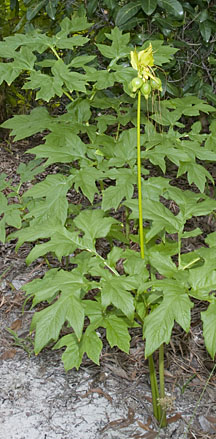 Pulau Semakau, Aug 11 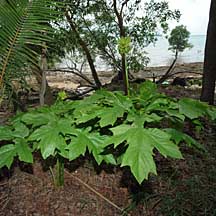 Grows in shady spots under coastal forest trees near the shoreline. Pulau Semakau, Dec 08 |
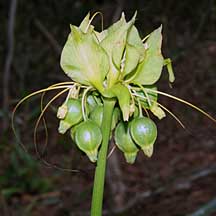 Fruits. Pulau Semakau, Dec 08 |
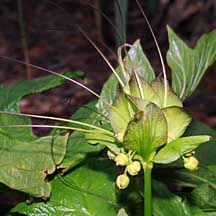 Flower cluster with 'whiskers'. Pulau Semakau, Dec 08 |
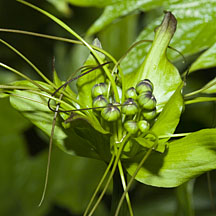 Flower cluster with 'whiskers'. Pulau Semakau, May 10 |
Seashore
bat lily on Singapore shores
| Photos for free download from wildsingapore flickr |
|
Links
References
|
 Singapore University Press. 215 pp.
|
|