 |
|
| plants text index | photo index |
| mangroves > Avicennia in general |
| Api-api
ludat Avicennia officinalis Family Acanthaceae updated Jan 2013 Where seen? This tree with pencil roots and glossy spoon-shaped leaves sometimes seen in our mangroves, but is not as commonly encountered as Avicennia alba. It is found on soft recently consolidated mudbanks, banks of river meanders and at river mouths. Hsuan Keng reported it being found in Changi, River Valley Road and Pulau Ubin. Features: Tree to 12m tall, sometimes 22m. Bark is smooth, with lenticels, light coloured and not fissured. Pencil-like pneumatophores. Often develops aerial stilt roots. Leaves often spoon-shaped, though sometimes not (8-10cm long). Upperside glossy green, underside finely hairy, greenish yellow but never white. The upperside may be encrusted in salt crystals especially in dry weather. Flowers large orange-yellow (about 1cm) in a tight cluster that is more or less globular in shape. The flowers are the largest of our Avicennia. According to Tomlinson, the flowers emit a rancid or fetid smell. It appears to bloom seasonally, with many A. officinalis trees blooming at the same time. Fruit oval slightly beaked (2-3cm long) smooth velvety. Human uses: According to Giesen, the fruits are eaten, and timber used as fuel while the bark resin is used in traditional medicine as a contraceptive. |
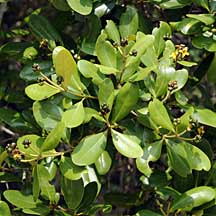 Pulau Ubin, Jun 09 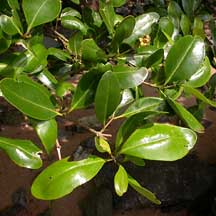 Leaves glossy and smooth. Chek Jawa, Jul 02 |
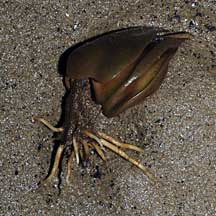 Seedling starting to grow. Berlayar Creek, Apr 09 |
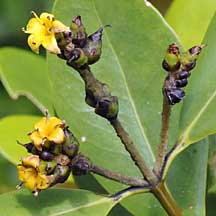 Large flowers, crowded together. Pulau Ubin, May 09 |
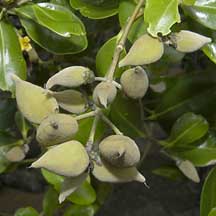 Fruits rounded with pointed tip. Chek Jawa, Aug 03 |
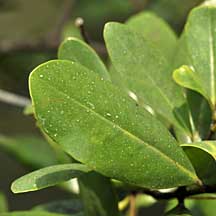 Salt crystals on upper surface in hot weather. Sungei Buloh Wetland Reserve, Feb 09 |
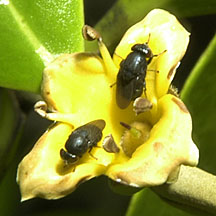 Pollinated by flies? Chek Jawa, Aug 03 |
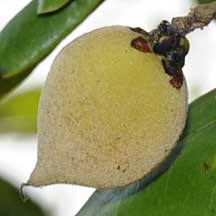 Pulau Ubin, Jun 09 |
| Api-api ludat on Singapore shores |
| Photos of Api-api ludat for free download from wildsingapore flickr |
| Distribution in Singapore on this wildsingapore flickr map |
|
Links
References
|
|
|