 |
|
| plants text index | photo index |
| mangroves > Avicennia in general |
| Api-api
bulu Avicennia rumphiana Family Acanthaceae updated Jan 2013 Where seen? This tree with pencil roots and velvety furry spoon-shaped leaves is sometimes seen in our mangroves, but is not as commonly encountered as Avicennia alba. It is found mainly in sandy or firm silt substrate of the mid to high water mark. It is considered among the largest of Avicennia species and it endemic to Southeast Asia. It can be common to very common where it is found, but it has a restricted range. It is also known as Avicennia lantana. Features: Tree up to 30m tall and 3m girth, but usually much smaller. Bark dark grey and smooth. Pencil-like pneumatophores, often with buttress roots. Leaves often spoon-shaped, but not always (8-10cm long). Green above, below olive or brownish with a velvety or furry texture. Young leaves in a pair are velvety - like rabbit ears. Flowers large orange-yellow (1cm) in a tight cluster that is more or less globular in shape. Very hairy outer petals and calyx. The flowers are said to be fragrant. The flower stalks are squarish, but stems not squarish all the way down. Fruit oval (1.5-2cm long) woolly often wrinkled. Contains one seed. Human uses: According to Giesen, the seeds are boiled and eaten and in some places sold in markets as vegetables. The fragrant flowers produce some of the best honey when collected by bees. The timber is used for buildings. It is rarely used to make charcoal and is used as firewood only to smoke fish or rubber. This fast growing mangrove tree is among the few used in mangrove replanting to protect coastlines. |
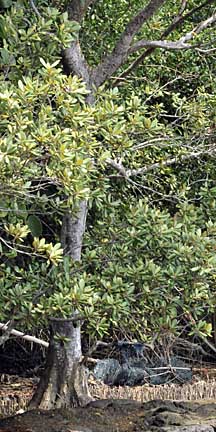 Pulau Semakau, Feb 09 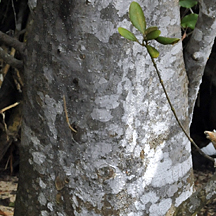 Pulau Semakau, Feb 09 |
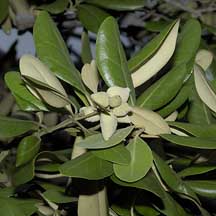 Leaves underneath white and velvety. Chek Jawa, Sep 03 |
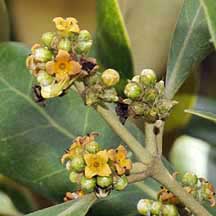 Large flowers, crowded together. Flower stalk squarish NOT to leaf-bearing portions. Pulau Semakau, Jan 09 |
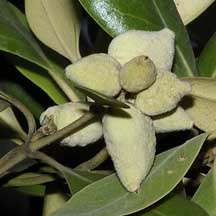 Fruits rounded, usually wrinkly, tips not so pointed. Chek Jawa, Sep 03 |
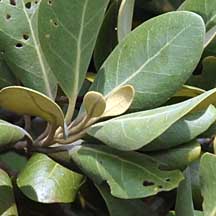 Young leaves velvety - like rabbit ears. Pulau Semakau, Feb 09 |
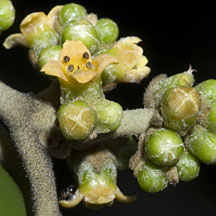 Furry stem, calyx and outer petals. Chek Jawa, Sep 03 |
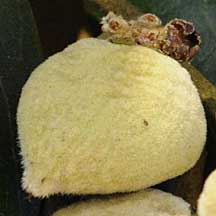 Pulau Ubin, Jun 09 |
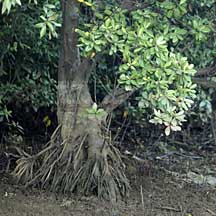 Stilt roots on old tree. Sungei Pandan, Jun 09 |
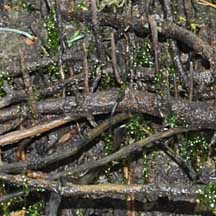 Eroded roots. Chek Jawa, Aug 09 |
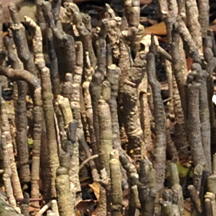 Pulau Semakau, Feb 09 |
| Api-api bulu on Singapore shores |
| Photos of Api-api bulu for free download from wildsingapore flickr |
| Distribution in Singapore on this wildsingapore flickr map |
|
Links
References
|
|
|