 |
|
| plants text index | photo index |
| mangroves > Bruguiera in general |
| Tumu
berau Bruguiera sexangula Family Rhizophoraceae updated Jan 2013 Where seen? This tree is not common in Singapore. Initially considered extinct in Singapore, it was rediscovered in 2005. There are two on Pulau Tekong, and two at Sungei Buloh and it is being replanted at Chek Jawa, Pulau Ubin and at Pasir Ris Park. According to Hsuan Keng, it was previously found in Kranji, Jurong and Tanjong Pasir Laba. Elsewhere, it is also considered widespread and uncommon throughout its range. It is found along tidal waterways, coastal fish ponds that are infrequently inundated. It was formerly called B. eriopetala. According to Burkill, 'Berau' in Malay suggests yellowness. Features: Tree up to 12m, sometimes 30m tall. Bark light brown-grey, smooth with a few large corky bumps (lenticels). The base of the trunk may be flanged and may have well developed aerial roots, sometimes forming stilt roots and knee roots. Leaves eye-shaped (8-16cm) stiff leathery glossy, arranged opposite one another. Stipules yellowish or pale. One flower on each pendulous flower stalk, large (2cm). Calyx has 10-12 lobes usually yellow, yellowish-brown, never conspicously scarlet although it may be reddish. Petals have a blunt tip with 1-2 short bristles or without tassels at the tips, white when fresh rapidly turning brown. According to Tomlinson, the large flowers are pollinated by birds. The petals of the flower hold loose pollen and are under tension. When probed at the base, the petal unzips to scatter a cloud of pollen over the head of the visiting bird. Propagule develops on the parent plant: hypocotyl shorter than other Bruguiera in Singapore (6-8cm long) fat angular ridged, narrow at both ends. The calyx lobes are extended away from the hypocotyl. According to the NParks Flora and Fauna website, the tree is the preferred local food plant for caterpillars of the moth Olene mendosa. Sometimes mistaken for Tumu (Bruguiera gymnorrhiza) but differs in smaller, thinner leaves and the flower petal tips are blunt without hairy tassels. Human uses: According to Burkill, the developing embryo is cooked, soaked overnight and then eaten. Juice from the fruits may be used to treat sore eyes, shingles or treat burns. According to Giersen, the heavy to very heavy timber is hard and strong. Used for poles as well as firewood and charcoal. In Sulawesi, the fruits are eaten after they are soaked and boiled. Status and threats: This plant is listed as 'Critically Endangered' on the Red List of threatened plants of Singapore |
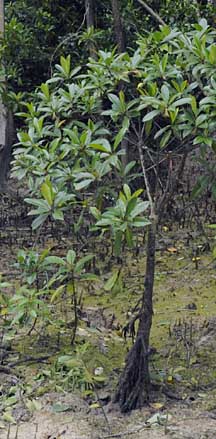 Pasir Ris, Jan 10 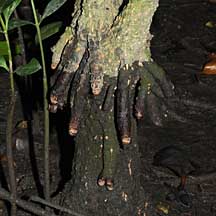 Chek Jawa, Mar 09 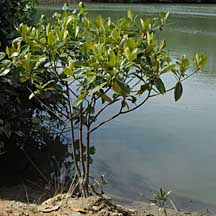 Pulau Ubin, Dec 09 |
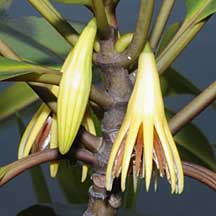 Large flowers, each on one stalk. Calyx usually yellow. Pulau Ubin, Dec 09 |
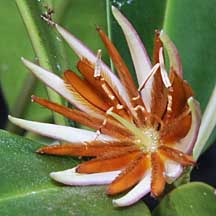 No tassels on petal tips. Pasir Ris, Jan 10 |
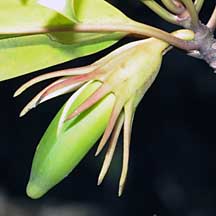 Sepals extend away from the propagule. Pasir Ris, Jan 10 |
| Tumu berau on Singapore shores |
| Photos Tumu berau for free download from wildsingapore flickr |
| Distribution in Singapore on this wildsingapore flickr map |
|
Links
References
|
|
|