 |
|
| plants text index | photo index |
| mangroves |
| Mangrove
wax plant Hoya sp. Family Apocynaceae updated Jan 2013 Where seen? These climbers with tough succulent leaves and beautiful wax-like flowers are sometimes seen in our mangroves. Here, they can sometimes drape thickly. According to Hsuan Keng, they used to be common including H. coronaria "common near the sea" at Serangoon, Changi, Kranji, Pulau Tekong, Ulu Berih; H. diversifolia "often densely covering trees" in Jurong, Chua Chu Kang, Kranji and Serangoon; H. verticillata (previously known as H. parasitica or H. ridleyi) "often near the sea" at Changi, Chua Chu Kang, Tuas, Krani and Pulau Tekong. With the loss of our mangroves, however, these plants are now less commonly seen. Features: Though not all Hoyas are vines, those in our mangroves are climbing twining vines that can be many metres long. Leaves (6-10cm) thick and succulent. Flowers emerge in a ball-like cluster. Each flower star-shaped with 5 waxy thick triangular petals, a smaller star-shaped structure in the centre. Fruits are long (10-15cm) bean-like which split open when ripe to release fluffy wind-dispersed seeds. A milky sap oozes out of cuts in the plant. Human uses: According to Burkill, uses include the latex to stimulate digestion. According to Hugh Tan, the poisonous latex is used in Malaysia to ease painful catfish stings, in hot baths to treat rheumatism and to cure coughs and asthma. Status and threats: Many of our hoyas are listed in the Red List of threatened plants of Singapore. The mangrove Hoya diversifolia is listed as 'Critically Endangered'. |
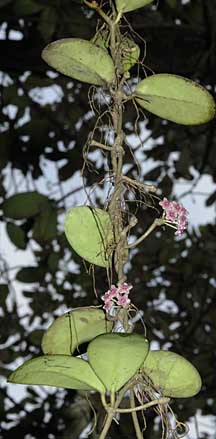 Lim Chu Kang, Apr 09 |
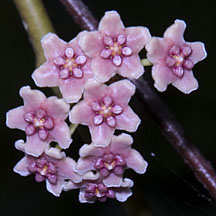 Admiralty Park, Aug 11 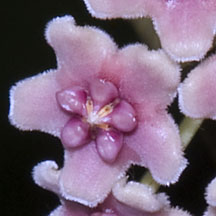 Hoya diversifolia |
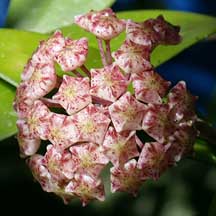 Chek Jawa, Dec 01 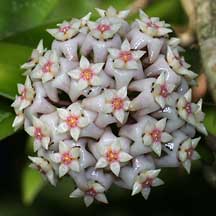 Hoya verticillata |
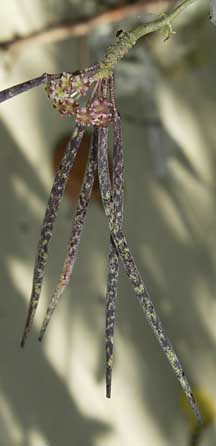 Fruits. Chek Jawa, May 03 |
| Mangrove wax plants on Singapore shores |
| Photos of Mangrove wax plants for free download from wildsingapore flickr |
| Distribution in Singapore on this wildsingapore flickr map |
|
Links
References
|
|
|