 |
|
| plants text index | photo index |
| mangroves |
| Pisang-pisang Kandelia candel Family Rhizophoraceae updated Jan 2013 Where seen? According to Ng, in Singapore, there is only one treelet found at Sungei Tampines. Occupies a narrow niche in the mangrove forest; occuring in the back mangrove communities or on the banks of tidal rivers farther inland. According to Hsuan Keng, it was rare and found in Kranji and Pasir Ris. According to Tomlinson, it is found from the Ganges Delta, Myanmar through Southeast Asia to China, the Ryu Kyu Islands and southern Japan. In the south, it is restricted to Sumatra and northern Borneo. It occupies a narrow niche, typically in the back mangrove or on banks of tidal rivers further inland. It is nowhere abundant. It was previously known as K. rheedii. Features: A small shrub or tree growing to 7m tall. No buttresses or pneumatophores. Bark smooth, greyish or reddish brown. Leaves narrow oblong or oval (7-12cm), glossy, arranged opposite one another. Leaf stalks sometimes pinkish. Stipules flattened but slightly twisted at the tip. Flowers (1.5-2cm long) white, calyx usually with 5-6 slender lobes, in clusters of usually 4 up to 9 flowers. According to Tomlinson, the flowers are pollinated by insects as nectar is secreted in the well developed calyx cup. He adds that the flowers attract a diversity of small flying insects. Propagule slender (25-40cm long) and tapered at each end, capped by the persistent sepals whose tips bend backwards to the fruit stalk. Human uses: According to Burkill, the timber is too small for any real value and it only used for firewood. Status and threats: This plant is listed as 'Critically Endangered' on the Red List of threatened plants of Singapore. |
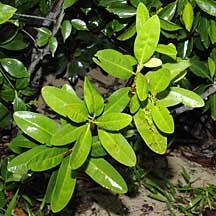 Pasir Ris, Aug 09  Propagule washed up on the shore. Changi, Oct 11 |
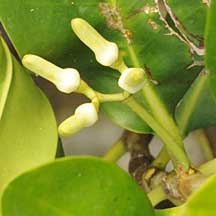 Pasir Ris, May 09 |
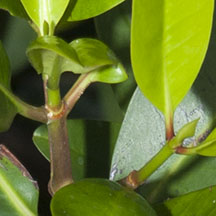 Pinkish leaf stlaks, flattened stipule. Pasir Ris, May 09 |
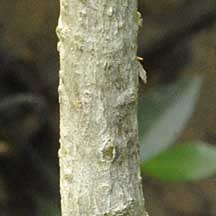 Pasir Ris, May 09 |
| Pisang-pisang on Singapore shores |
| Photos of Pisang-pisang for free download from wildsingapore flickr |
| Distribution in Singapore on this wildsingapore flickr map |
|
Links
References
|
|
|