 |
|
|
Longspined
waspfish
Paracentropogon longispinis
Family Tetrarogidae
updated Oct 2020
if you
learn only 3 things about it ...
 It is small and well camouflaged. Look carefully to find
one. It is small and well camouflaged. Look carefully to find
one.
It has venomous spines. Don't handle it!
Its
venom is only used for protection from predators and not
to catch prey. |
|
Where
seen? This little waspfish is commonly seen on many of
our shores, among coral rubble or seagrasses. But it is small and
well camouflaged and thus often overlooked. Now in Family Tetrarogidae
(waspfishes), it used to be placed in Family Scorpaenidae (scorpionfishes).
Features: 5-7cm long. The dorsal
fin begins almost between its eyes and the dorsal fin membranes are
deeply incised between the spines. It has a pair of large backward
pointing spines above its mouth, which may not be obvious when the
spines are folded away. The lateral line has prominent tube-like scales.
Some may have a white band across the face, and indeed, they are called
Whiteface waspfish in some places. In captivity, they have been observed
to change from light to dark colours.
Sometimes mistaken for a stonefish (Family Synanceiidae) or the False
scorpionfish (Centrogenys vaigiensis), a grouper, which
looks very similar. Here's more on how
to tell apart fishes that look like stones. |
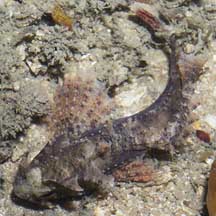
Chek Jawa, Jun 05 |
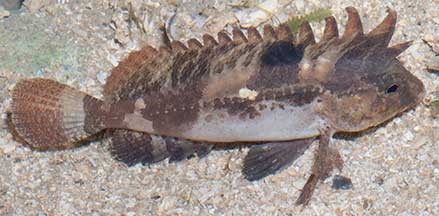 Prominent tube-like scales
along the lateral line.
Prominent tube-like scales
along the lateral line.
Deeply incised membranes between dorsal fin spines
Pulau Sekudu,
Apr 06 |
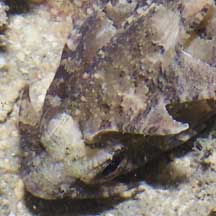
Backward facing spines next to the mouth,
First dorsal fin almost between the eyes. |
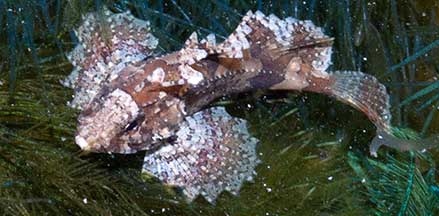 Sentosa, Nov 10
 |
Painful
sting! According to an account of being stung on a finger: "There was a sharp initial pain, developing into a throbbing pain felt to the bone, soon spreading to the rest of the finger. The intense pain remained for about an hour, the whole arm felt rather weak. The throbbing pain gradually subsided to a dull ache, which continued to persist for about two weeks."
How to stay safe: Don't grope around with bare hands. |
|
| Human uses: These fishes are sometimes
taken for the aquarium trade.. |
| Longspined
waspfishes on Singapore shores |
| Other sightings on Singapore shores |
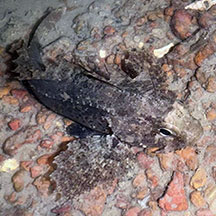
Beting Bronok, Jun 25
Photo shared by Kelvin Yong on facebook. |
|
|
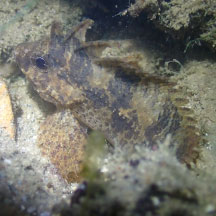
Labrador, Oct 25
Photo shared by Jonathan Tan on facebook. |
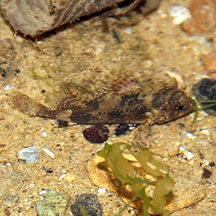
Berlayar Creek, Oct 15
Photo shared by Jonathan Tan on facebook. |
|
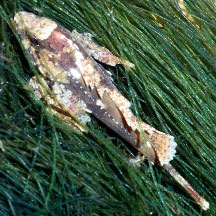 Sentosa Tg Rimau, Oct 25
Photo shared by Loh Kok Sheng on facebook. |
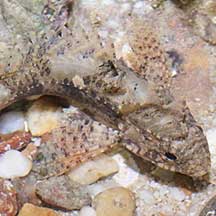
Pulau Tekukor, May 10
Photo shared by James Koh on flickr. |
|
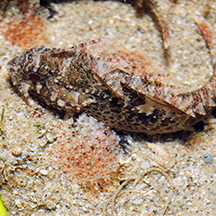
Seringat-Kias, Nov 14
Photo shared by Loh Kok Sheng on facebook. |
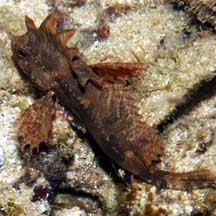
Sisters Island, Aug 09
Photo shared by Liana Tang on her
blog. |
|
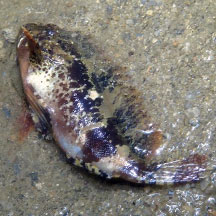
Terumbu Hantu, Jul 18
Photo shared by Jianlin Liau on facebook. |
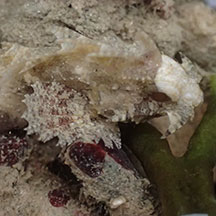
Terumbu Raya, Jun 18
Photo shared by Dayna Cheah on facebook. |
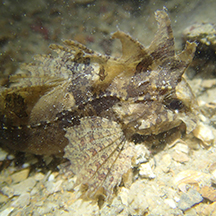
Terumbu Pempang Tengah, Sep 14
Photo shared by Jianlin Liau on facebook. |
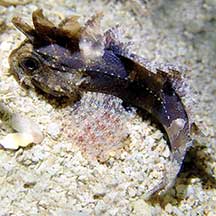
Pulau Salu, Apr 21
Photo shared by Jianlin Liau on facebook. |
|
|
Links
References
- Tan Heok Hui. 29 July 2016. Stung by a longspine waspfish. Singapore Biodiversity Records 2016: 98-99
- Lim, S.,
P. Ng, L. Tan, & W. Y. Chin, 1994. Rhythm of the Sea: The Life
and Times of Labrador Beach. Division of Biology, School of
Science, Nanyang Technological University & Department of Zoology,
the National University of Singapore. 160 pp.
|
|
|