 |
|
| crabs text index | photo index |
| Phylum Arthropoda > Subphylum Crustacea > Class Malacostraca > Order Decapoda > Brachyurans |
| Coral
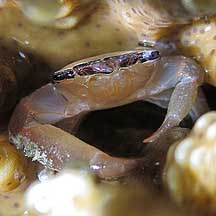
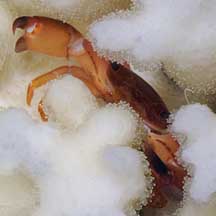
crabs Superfamily Trapezioidea updated Dec 2019 Where seen? These tiny crabs are only found in living branching hard corals such as Acropora corals (Acropora sp.) and Cauliflower corals (Pocillopora sp.). They are well hidden and quick, and thus hard to spot and photograph. Features: Body width about 1cm. The body is flat and usually pentagonal (hard to see this on living crabs which are usually well hidden). The pincers are large (relative to the body), with pointed pincers. The legs are short with pointed tips. Usually a pair of male and female are found in one coral colony. The females are generally larger than the males and the males have claws that are proportionally larger. These coral crabs feed on the mucus produced by the hard coral, gathering these with the minute comb-like structures at the tips of their feet. The Red coral crab (Trapezia cymodoce) lives only in Cauliflower corals (Pocillopora sp.). The Bandit coral crab (Tetralia nigrolineata) lives only in Acropora corals (Acropora sp.). Other tiny crabs that live in corals include the Hairy coral crab (Cymo andreossyi) Status and threats: The Red coral crab (Trapezia cymodoce) is listed as 'Vulnerable' in our Red List of threatened animals of Singapore. To protect these crabs, we need to protect their hard coral homes. |
| Some Coral crabs on Singapore shores |
| Superfamily
Trapezioidea recorded for Singapore from Wee Y.C. and Peter K. L. Ng. 1994. A First Look at Biodiversity in Singapore *from Tan, Leo W. H. & Ng, Peter K. L., 1988. A Guide to Seashore Life. **from Lim, S., P. Ng, L. Tan, & W. Y. Chin, 1994. Rhythm of the Sea: The Life and Times of Labrador Beach. +from The Biodiversity of Singapore, Lee Kong Chian Natural History Museum. in red are those listed among the threatened animals of Singapore from Davison, G.W. H. and P. K. L. Ng and Ho Hua Chew, 2008. The Singapore Red Data Book: Threatened plants and animals of Singapore. ^from WORMS
|
References
|