 |
|
| hermit crabs text index | photo index |
| Phylum Arthropoda > Subphylum Crustacea > Class Malacostraca > Order Decapoda > Anomurans > hermit crabs |
| Clibanarius
hermit crabs Clibanarius spp. Family Diogenidae updated Mar 2020 Where seen? These are among the most commonly seen large hermit crabs on our shores. 'Clibanarius' in Latin refers to a soldier in chain mail. Features: Body 2-4cm long. Both pincers are more or less equal in size and held so that the 'fingers' open horizontally in front of the animal. Many species have boldly coloured stripes on their long walking legs. Eyes on thick long eye stalks. |
|
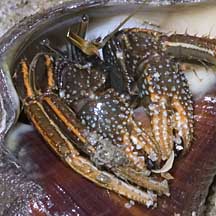
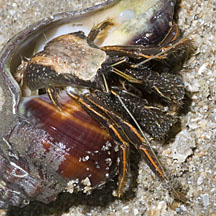
Orange-striped
hermit crab
Clibanarius infraspinatus |
||
 |
 |
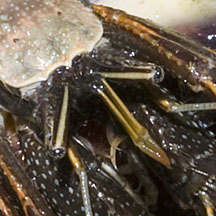 |
| Pincers equal sized, brown with orange claws. Walking legs with orange stripes. | Body pale near the eyes, towards the 'tail' with broad dark brown and pale orange stripes. Body sides dark with white dots. | Eye stalks brown with pale stripes. Short antennae and long antennae pale orange. |
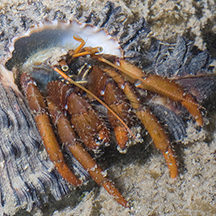
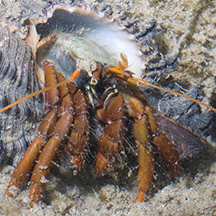
Tawny
hermit crab Clibanarius sp. |
||
 |
 |
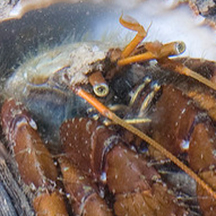 |
| Pincers equal sized, brown with orange claws. Walking legs uniformly dark orange, no stripes. | Body all white . | Eye stalks brown. Short antennae and long antennae bright orange. |
|
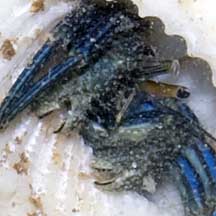
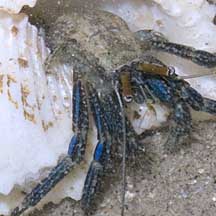
Blue-striped
hermit crab
Clibanarius longitarsus |
||
 |
 |
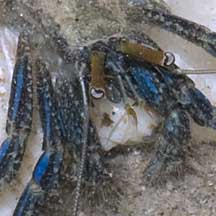 |
| Pincers equal sized, uniform colour. Walking legs with blue stripes. | Body plain pale. | Eye stalks olive, unstriped. Short antennae and long antennae dull brown or olive. |
|
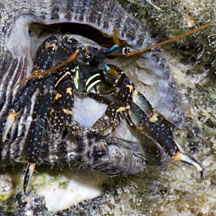
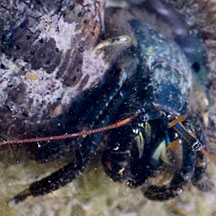
All-black
hermit crab
Clibanarius sp. |
||
 |
 |
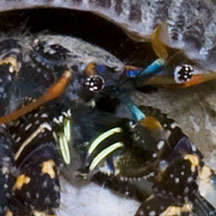 |
| Pincers equal sized. Pincers and walking legs black with tiny white dots and orange joints. | Body plain dark or pale. | Eye stalks olive, unstriped. Short antennae and long antennae dull brown or olive. |
|
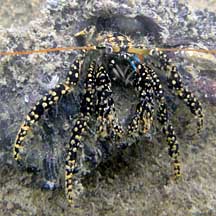
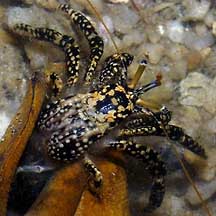
Gold-spotted
hermit crab
Clibanarius cruentatus |
||
 |
 |
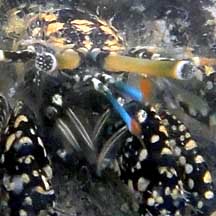 |
| Pincers equal sized. Pincers and walking legs black with large irregular gold spots. | Body black with large orange-yellow spots, near the eyes, spots larger and more orange | Eye stalks olive, unstriped. Short antennae and long antennae dull brown or olive. |
|
References
|