 |
|
|
Lobsters
and lobster-like crustaceans
updated
Mar 2020
Where
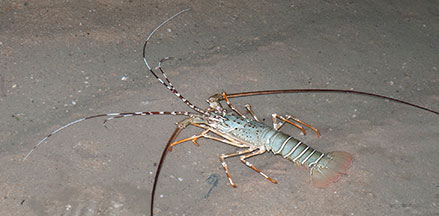
seen? Among our favourite seafood, lobsters do exist on our shores but they
are usually found in deeper waters and only sometimes seen by divers.
During the day, they are usually well hidden among corals. Those seen
on the intertidal, were sadly trapped in drift nets. Some relatives
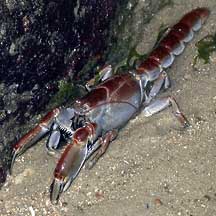
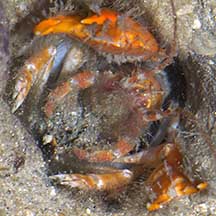
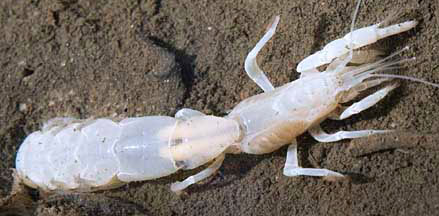
such as mud lobsters and ghost shrimps are also common though rarely
seen.
What are lobsters? Lobsters and their relatives are crustaceans that belong to various Infraorders in the larger Order Decapoda.
The Family Palinuridae include some of the lobsters that we eat. There
are other lobster-like animals that are not really shrimps. Those
more commonly found on our shores include the mud
lobsters and ghost shrimps and mud
shrimps.
Features: Like shrimps, lobsters
and lobster-like crustaceans have a long body and broad tail, and long
antennae. Lobsters have heavy shells, unlike the light flexible exoskeletons
of shrimps. Lobsters and lobster-like crustacea have heavier legs
and tend to have powerful claws. They don't have swimmeretes (pleopods)
like shrimps do. But they can also rapidly move backwards by flexing
the abdomen and broad tail.
Human uses: Larger lobsters are
harvested as seafood everywhere. |
| Some lobsters and lobster-like crustaceans on Singapore shores |
Lobsters
and lobster-like crustacea recorded for Singapore
from Wee Y.C. and
Peter K. L. Ng. 1994. A First Look at Biodiversity in Singapore.
in red are those listed among the threatened
animals of Singapore from Davison, G.W. H. and P. K. L. Ng
and Ho Hua Chew, 2008. The Singapore Red Data Book: Threatened
plants and animals of Singapore.
*from Tan, Leo W. H. & Ng, Peter K. L., 1988, A Guide to Seashore
Life
**from Lim, S., P. Ng, L. Tan, & W. Y. Chin, 1994. Rhythm of
the Sea: The Life and Times of Labrador Beach.
+from our observation.
Infraorder
Palinura
Infraorder
Thalassinidae
| |
**Family
Callianassidae (ghost shrimps) |
| |
Family
Thalassinidae (mud lobsters) |
| |
Thalassina
sp. (Mud lobsters)
Thalassina anomala (EN:
Endangered)
Thalassina gracilis (EN: Endangered) |
| |
*Wolffogebia
phuketensis (Mud shrimp) (EN:
Endangered) |
|
References
- Wee Y.C.
and Peter K. L. Ng. 1994. A First Look at Biodiversity in Singapore.
National Council on the Environment. 163pp.
- Davison,
G.W. H. and P. K. L. Ng and Ho Hua Chew, 2008. The Singapore
Red Data Book: Threatened plants and animals of Singapore.
Nature Society (Singapore). 285 pp.
- Jones Diana
S. and Gary J. Morgan, 2002. A Field Guide to Crustaceans of
Australian Waters. Reed New Holland. 224 pp.
- Debelius,
Helmut, 2001. Crustacea
Guide of the World: Atlantic Ocean, Indian Ocean, Pacific Ocean
IKAN-Unterwasserachiv, Frankfurt. 321 pp.
- Gosliner,
Terrence M., David W. Behrens and Gary C. Williams. 1996. Coral
Reef Animals of the Indo-Pacific: Animal life from Africa to Hawaii
exclusive of the vertebrates
Sea Challengers. 314pp.
|
|
|