Tellin
clams
Family Tellinidae
updated
May 2020
Where
seen? The clam or its empty shells are sometimes seen on
some of our shores. Elsewhere, they are active burrowers in soft bottoms
where they may be found in dense communities.
What are tellin clams? Tellin
clams belong to Family Tellinidae.
Features: About 5cm. Tellin clams
have a two-part shell. They are specialised for deep burrowing and
generally have narrow thin shells, a wide blade-like foot and long
siphons to reach the surface. Tellin clams also have the haemoglobin
which give the animal a bright red color. The shells of some Tellin
clam species can be quite colourful.
What do they eat? Unlike other
bivalves filter feed, Tellin clams use their long siphons like vacuum
cleaners to suck up edible bits that settle on the bottom. They do
this while their shells are safely tucked away deep in the ground,
often in a horizontal position.
Human
uses: Some are collected for food and the shell trade. |
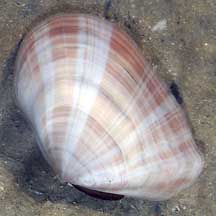
Pulau Semakau,
Mar 05 |
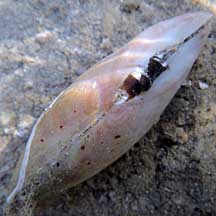 Pulau Semakau,
Apr 11
Pulau Semakau,
Apr 11 |
|
| Tellin
clams on Singapore shores |
| Other sightings on Singapore shores |
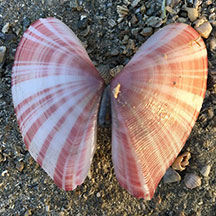 Pulau Hantu, May 19
Photo shared by Joleen Chan on facebook. |
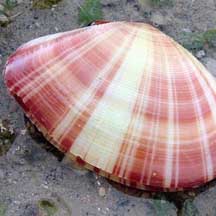 St. John's
Island, Jul 09
St. John's
Island, Jul 09
Photo shared by Geraldine Lee on her
blog. |
|
Family
Tellinidae recorded for Singapore
from
Tan Siong Kiat and Henrietta P. M. Woo, 2010 Preliminary Checklist
of The Molluscs of Singapore.
+Other additions (Singapore Biodiversity Record, etc)
| |
Arcopagia
pinguis
Jactellina hungerfordi
Macalia bruguieri
Macoma fallax
Pharaonella rostrata
+Quidnipagus palatum
Scutarcopagia linguafelis
Scutarcopagia scobinata
Tellina capsoides
Tellina emarginata
Tellina remies
Tellina rhodon
Tellina robusta
Tellina scalpellum
Tellina spengleri
Tellina staurella
+Tellinides timorensis
Tellina virgata
Tellinella pulcherrima |
|
Links
References
- Tan Siong Kiat & Martyn E. Y. Low. 13 December 2013. Two new Singapore records of the bivalve family Tellinidae: Quidnipagus palatum, Tellinides timorensis. Singapore Biodiversity Records 2013: 116-117.
- Tan Siong
Kiat and Henrietta P. M. Woo, 2010 Preliminary
Checklist of The Molluscs of Singapore (pdf), Raffles
Museum of Biodiversity Research, National University of Singapore.
- Tan, K. S.
& L. M. Chou, 2000. A
Guide to the Common Seashells of Singapore. Singapore
Science Centre. 160 pp.
- Wee Y.C.
and Peter K. L. Ng. 1994. A First Look at Biodiversity in Singapore.
National Council on the Environment. 163pp.
- Ng, P. K.
L. & Y. C. Wee, 1994. The
Singapore Red Data Book: Threatened Plants and Animals of Singapore
 .
The Nature Society (Singapore), Singapore. 343 pp. .
The Nature Society (Singapore), Singapore. 343 pp.
- Abbott, R.
Tucker, 1991. Seashells
of South East Asia.
Graham Brash, Singapore. 145 pp.
|
|
|