Molluscs
Phylum Mollusca
updated
Sep 2020
if you
learn only 3 things about them ...
 Besides
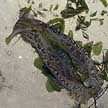
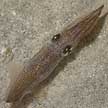
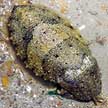
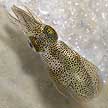
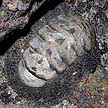
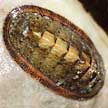
shelled snails, molluscs include slugs, octopuses, squids
and cuttlefishes. Besides
shelled snails, molluscs include slugs, octopuses, squids
and cuttlefishes.
They
have a tongue that is specialised to eat their food or
prey.
Molluscs include some of the smartest and largest invertebrates. |
|
While most people
will find other invertebrates boring, almost no one can resist a mollusc.
Delicious! For a start, molluscs
are among our favourite seafood! Some snails and clams have also attractive
shells. Octopus are among the smartest invertebrates, the Giant squid
is believed to be the largest invertebrate, while nudibranchs are
among the most beautiful sea creatures.
Different! Generalisations are difficult
to make for this large and diverse Phylum. Major Classes under the
Phylum include: Gastropoda (snails and
slugs), Bivalvia (clams), Cephalopoda (octopus, squids and cuttlefishes). Not surprisingly, there isn't
really such a thing as a 'typical' mollusc. |
| Mind-boggling Molluscs: Molluscs
range from immobile oysters stuck to a rock, slow moving snails with
large extenal shells, to speedy squids with light internal shells.
While many may be dull, some like nudibranchs are among the most colourful
marine creatures. The star of the molluscs are possibly the octopuses:
the smartest of invertebrates, with some studies showing that they
can learn. On the shores, molluscs may be tiny and microscopic, to
enormous giant clams that can reach 40cm or more. In the deep sea,
some squids can grow to monstrous size! |
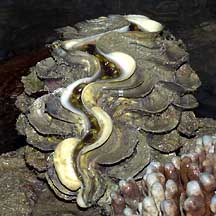
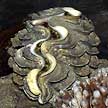
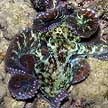
The Giant clam is among
the largest bivalves on our shore.
Sisters Island,
Jan 04 |
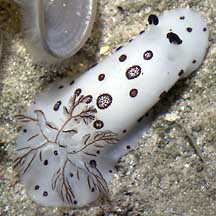
The startling white colour of this Polka-dot nudibranch
warns that it's not good to eat.
Sentosa, Mar 05 |
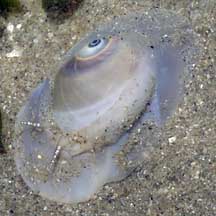
The body of a moon snail can expand to be
MUCH bigger than the shell
Changi, Jun 06 |
Soft
and squishy: 'Mollis' means 'soft-bodied'. Indeed, among
the few features shared by all molluscs is a soft body. To protect
this soft body, some snails produce a shell, while clams produce a
two-part shell. Slugs that lack shells often have toxins and other
defences. Others like squids and cuttlefish rely on speed instead.
Big
foot: In many molluscs, a large foot makes up much of the
body. The foot has cells that produce mucous to help them move over
a surface. The foot is often extensively modified in some members
such as octopuses and squids. |
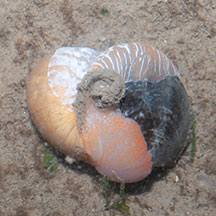
A moon snail with a bivalve enveloped in its foot.
Changi, Aug 12 |
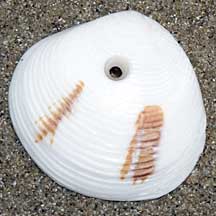
Clam shell with hole neatly drilled,
possibly by a moon snail?
Changi, Oct 10 |
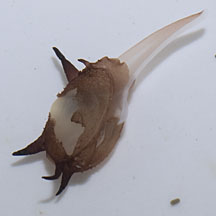
The Scintilla clam uses its foot to
creep around or even 'jump'.
Terumbu Semakau, Jun 12 |
Terrible tongue: Most molluscs also
have a radula; a firm ribbon-like structure made of protein-chitin,
covered with sharp teeth made of chitin. The radula is usually used
for feeding and can modified in amazing ways to rasp, grate, grasp,
cut, stab and inject poison. For example, drills are snails that use
their radula to make a hole through their hard-shelled prey. Here
are diagrams of how a grazing
snail uses its radula to feed on algae.
Other features: Many molluscs
also have tentacles, a pair of eyes and a pair of balance organs.
Most also have an osphradia, a sensory patch inside the body that
is believed to process chemicals in the water flowing into the body.
Most molluscs have gills. These are often inside a chamber in the
body called a mantle cavity. Most also have a circulatory system and
a heart, as well as kidneys.
Sometimes confused with barnacles,
which are crustaceans like crabs and shrimps. Here's more on how to
tell apart animals with conical
shells that are found on rocks.
Mollusc babies: Most molluscs
have separate genders. Although most slugs are simultaneous hermaphrodites, that is, each animal has both male
and female reproductive organs at the same time. The details of the way each reproduces is covered
in the fact sheets on them. |
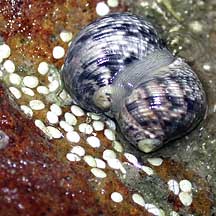
Nerites mating with their white egg capsules.
Chek Jawa, Feb 02 |
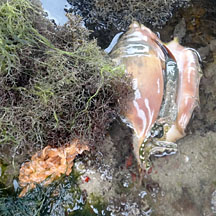
The Spider conch lays bright orange egg strings.
Terumbu Hantu, Apr 12 |
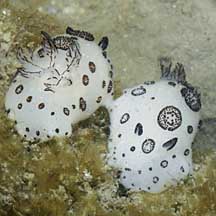
A pair of Polka-dot nudibranchs possibly mating.
Pulau Semakau, Jul 08 |
Human uses: Molluscs have been
exploited by humans for millenia. Uses range from food to adornments
(dyes, shells, pearls) to even money (cowrie shells). Molluscs continue
to play some of these roles today. In addition, some molluscs are
being studied for modern medical applications. For example, the toxins
of the highly venomous cone shells (Family Conidae) are being studied
for applications in pain control.
Status and threats: Sadly, many
of our beautiful and fascinating molluscs are listed among the threatened
animals of Singapore. Like other marine creatures, molluscs are vulnerable
to habitat loss due to reclamation or human activities along the coast
that pollute the water. They are also vulnerable to trampling by careless
visitors and over-collection for food and for their shells can affect
local populations. |
Threatened
marine molluscs of Singapore
from
Davison, G.W. H. and P. K. L. Ng and Ho Hua Chew, 2008. The Singapore
Red Data Book: Threatened plants and animals of Singapore.
Gastropoda:
Snails with shells
| |
Cerithium
trailli (Traill's cerith) (EN: Endangered) |
| |
Conus
consors (Singed cone) (VU: Vulnerable)
Conus textile (Textile cone) (VU: Vulnerable) |
| |
Cypraea
annulus (Gold-ringed cowrie) (EN: Endangered)
Cypraea arabica
(Arabian cowrie) (VU: Vulnerable)
Cypraea tigris
(Tiger cowrie) (EN: Endangered) |
| |
Ellobium
aurismalchi (Mangrove land snail) (CR: Critically endangered) |
| |
Scutus sp.
(Hoof-shield limpet)
*Scutus unguis (EN: Endangered) |
| |
Haliotis
asinina (EN: Endangered)
Haliotis clathrata (EN: Endangered)
Haliotis dohrniana (EN: Endangered)
Haliotis varia (EN: Endangered)
Haliotis ovina (EN: Endangered)
Haliotis planata (EN: Endangered) |
| |
Harpa
major (Major Harp) (EN: Endangered) |
| |
Chicoreus
ramosus (Ramose murex) (EN: Endangered)
Murex trapa
(Rare-spined murex) (VU: Vulnerable) |
| |
Oliva
sericea (Orange-mouth olive) (VU: Vulnerable) |
| |
Trivirostra
oryza (EN: Endangered) |
| |
Turbo
petholatus (Tapestry turban) (VU: Vulnerable) |
| |
Turritella
sp. (Turritella snail)
Turritella terebra (Screw turritella) (VU: Vulnerable) |
Bivalvia
(Clams)
| |
Verpa
penis (Watering pot shell) (NE: Presumed extinct) |
| |
Atrina
vexillum (VU: Vulnerable)
Pinna bicolor (VU: Vulnerable) |
Gastropoda: Slugs and others
| |
Acanthopleura
gemmata (EN: Endangered) |
| |
Peronina
alta (DD: Data deficient) |
Cephalopods (Octopus, squid, cuttlefish)
none listed
Land snails
| |
Amphidromus
atricallosus perakensis (Green tree snail) (EN: Endangered)
Amphidromus inversus (Brown tree snail) (CR: Critically
endangered) |
|
Links
References
- Tan Siong
Kiat and Henrietta P. M. Woo, 2010 Preliminary
Checklist of The Molluscs of Singapore (pdf), Raffles
Museum of Biodiversity Research, National University of Singapore.
- Tan, K. S.
& L. M. Chou, 2000. A Guide to the Common Seashells of Singapore.
Singapore Science Centre. 160 pp.
- Davison,
G.W. H. and P. K. L. Ng and Ho Hua Chew, 2008. The Singapore
Red Data Book: Threatened plants and animals of Singapore.
Nature Society (Singapore). 285 pp.
- Abbott, R.
Tucker, 1991. Seashells of South East Asia. Graham Brash,
Singapore. 145 pp.
- Debelius,
Helmut, 2001. Nudibranchs and Sea Snails: Indo-Pacific Field
Guide. IKAN-Unterwasserachiv, Frankfurt. 321 pp.
- Coleman,
Neville. 2003. 2002 Sea Shells: Catalogue of Indo-Pacific Mollusca.
Neville Coleman's Underwater Geographic Pty Ltd, Australia.144pp.
- Edward E.
Ruppert, Richard S. Fox, Robert D. Barnes. 2004.Invertebrate
Zoology
Brooks/Cole of Thomson Learning Inc., 7th Edition. pp. 963
- Pechenik,
Jan A., 2005. Biology
of the Invertebrates.
5th edition. McGraw-Hill Book Co., Singapore. 578 pp.
|
|
|