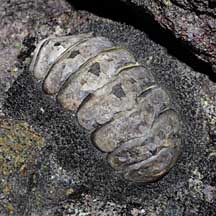
 |
|
|
Chitons
Class
Polyplacophora
updated Jun 2020
if you
learn only 3 things about them ...
 Although they have segmented shells, they are molluscs
and not crustaceans. Although they have segmented shells, they are molluscs
and not crustaceans.
Most are tiny and hard to spot.
They
cling on tenaciously. Don't try to pry them off. Leave
them alone! |
|
Where
seen? These odd creatures with segmented armour is sometimes
seen on many of our shores. On hard surfaces such as rocks as well as large flat clams such
as Window pane shell clams (Placuna sp.) and Fan shell clams (Family
Pinnidae). Most are tiny and overlooked. But once, Jewelled chitons can be enormous!
What are chitons? Chitons are molluscs (Phylum Mollusca) like snails,
slugs and clams. They belong to a separate Class Polyplacophora. About
half the chiton species are found in shallow waters, while the rest
are found in deep water.
Features: Ranging from 3mm to
40cm, most are about 3-12cm long. Those on our shores tend to be 3cm
or less. These sluggish animals are adapted for clinging tenaciously
to a hard surface. A chiton is basically just a large flat foot. The
oval flattened body is made up of a thick body with 8 overlapping
plates along the centre. 'Polyplacophora' means 'bearer of many plates'.
The animal is sometimes also called coat-of-mail mollusc. A thick,
stiff mantle covers the body forming a girdle around the plates to
the body edges. The girdle may be smooth, or have scales or bristles. |
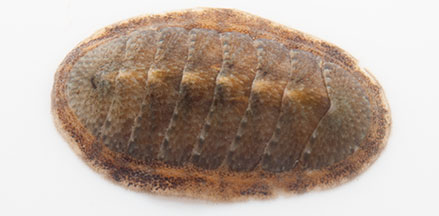
Changi, Jan 12 |
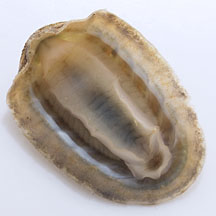
Underside. |
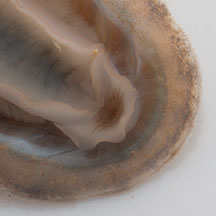
Mouth. |
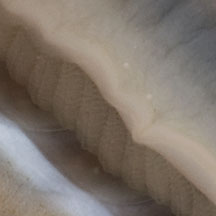
Gills on the side of the body. |
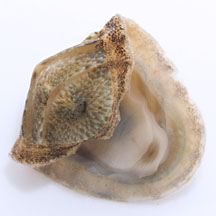
It can curl up. |
A chiton can create a powerful suction to cling tenaciously onto a
hard surface. According to Ruppert "A chiton forewarned is almost
impossible to remove without damaging the animal". If it is dislodged,
the animal can curl up into a ball.
A chiton has no eyes, tentacles and in fact, the head is described
as "poorly developed and indistinct".
Sometimes mistaken for a scale
worm which is a polychaete worm that also has overlapping scales
but has well developed tentacles and rows of bristles along the sides
of the body. |
|
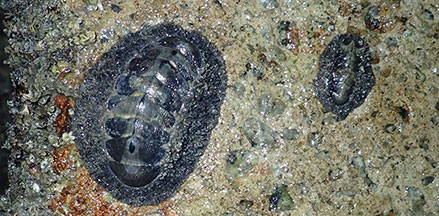
A large and small one found on artificial seawall.
Seringat-Kias, Jan 19 |
What do they eat? Like snails,
chitons have a rough 'tongue' called a radula that is used to rasp
off fine algae or other encrustations. They creep slowly about when
submerged and at night. When exposed at low tide and during the day,
they are usually motionless in some dark, wet hiding place.
Status and threats: A large chiton found on our shores, the Jewelled chiton (Acanthopleura gemmata) is listed as 'Endangered' on
the Red List of threatened animals of Singapore. |
| Unidentified chitons
on Singapore shores |
| Other sightings on Singapore shores |
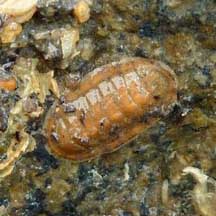
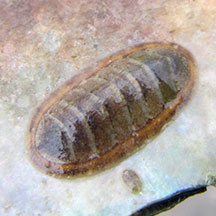
Pulau Ubin, Dec 09
Photo shared by Loh Kok Sheng on flickr. |
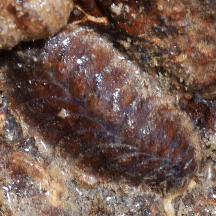
Chek Jawa, Dec 19
Photo shared by Frances Loke on facebook. |
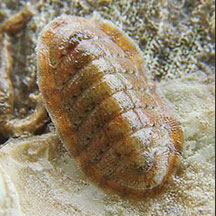
Tuas, Jun 15
Photo shared by Loh Kok Sheng on facebook. |
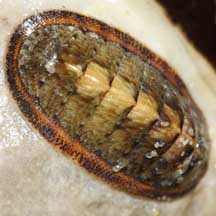
East Coast Park, Mar 10
Photo shared by James Koh on flickr. |
Tanah Merah, Jul 09
Photo shared by James Koh on flickr. |
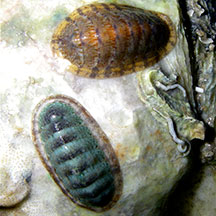
Tanah Merah, Jun 08
Photo shared by Toh Chay Hoon on flickr. |
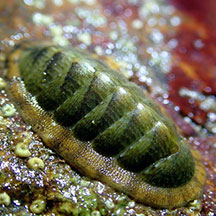 Berlayar Creek, Feb 20 Berlayar Creek, Feb 20
Photo shared by Jianlin Liu on facebook. |
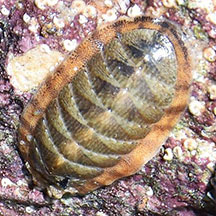 Berlayar Creek, Feb 20 Berlayar Creek, Feb 20
Photo shared by Loh Kok Sheng on facebook. |
|
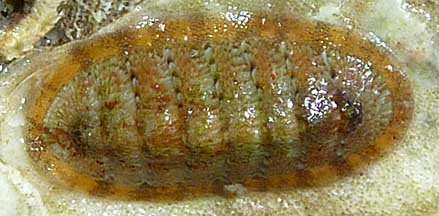
East Coast Park, Mar 10
Shared by Loh Kok Sheng on his
flickr. |
|
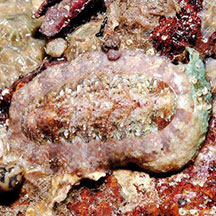
Sentosa, May 13
Photo shared by Loh Kok Sheng on flickr. |
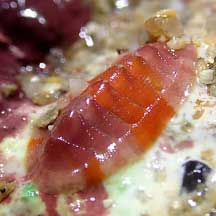
Kusu Island, Jun 21
Photo shared by Jianlin Liu on facebook. |
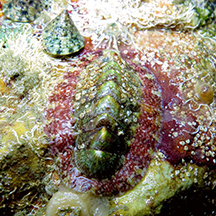
Big Sisters Island, Feb 17
Photo shared by Jianlin Liu on facebook. |
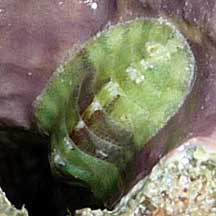
Pulau Tekukor, May 10
Photo shared by Loh Kok Sheng on his
blog. |
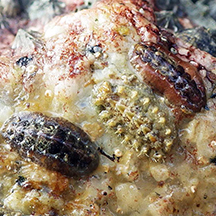
Pulau Semakau East, Jul 15
Photo shared by Loh Kok Sheng on facebook. |
|
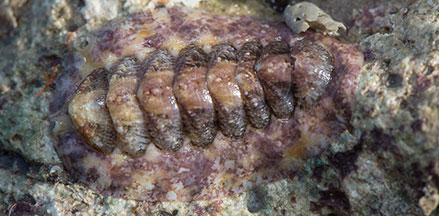
Pulau Jong, Jun 12
Photo shared by Marcus Ng on flickr. |
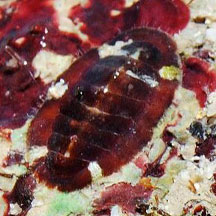
Pulau Jong, Jul 12
Photo shared by Loh Kok Sheng on flickr. |
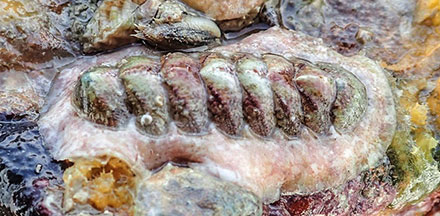
Cyrene Reef, Aug 20
Photo shared by Vincent Choo on facebook. |
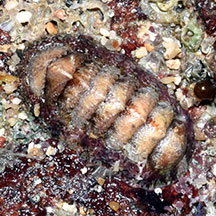
Raffles Lighthouse, Nov 16
Photo shared by Loh Kok Sheng on facebook. |
Class
Polyplacophora recorded for Singapore
from
Tan Siong Kiat and Henrietta P. M. Woo, 2010 Preliminary Checklist
of The Molluscs of Singapore
^from WORMS
Order
Neoloricata
|
Links
References
- Tan, S. K.
& H. P. M. Woo, 2010. A preliminary checklist of the molluscs
of Singapore. Lee Kong Chian Natural History Museum, National
University of Singapore, Singapore. 78 pp.
- Tan, K. S.
& L. M. Chou, 2000. A
Guide to the Common Seashells of Singapore. Singapore
Science Centre. 160 pp.
- Davison,
G.W. H. and P. K. L. Ng and Ho Hua Chew, 2008. The Singapore
Red Data Book: Threatened plants and animals of Singapore.
Nature Society (Singapore). 285 pp.
- Gosliner,
Terrence M., David W. Behrens and Gary C. Williams. 1996. Coral
Reef Animals of the Indo-Pacific: Animal life from Africa to Hawaii exclusive of the vertebrates
Sea Challengers. 314pp.
- Edward E.
Ruppert, Richard S. Fox, Robert D. Barnes. 2004. Invertebrate
Zoology
Brooks/Cole of Thomson Learning Inc., 7th Edition. pp. 963.
|
|
|