 |
|

| cephalopods text index | photo index |
| Phylum Mollusca > Class Cephalopoda | squids and cuttlefihes | octopuses |
| Cephalopods Class Cephalopoda updated May 2020
Where seen? Cephalopods can be commonly seen on many of our shores. Octopuses, in particular, are far more common than most people would imagine. They are usually well hidden or camouflaged. Cuttlefishes too are common, especially small ones. Squids and large cuttlefishes, however, appear to be only seasonally common. What are cephalopods? Cephalopods are molluscs (Phylum Mollusca) like snails, slugs and clams. The Class Cephalopoda include octopuses, squids and cuttlefishes. Another member of this group are the nautilus shells. Cephalopods are generally fast moving, many-armed hunters. Quite different from the more typical snails, slugs and clams that we think of as molluscs. There are nearly 800 species of cephalopods. No Shells: Aside from the nautilus, other cephalopods have no external shells. Octopuses have no shells at all. Squids and cuttlefishes retain a small internal shell which helps to stiffen their bodies and in cuttlefishes, to control bouyancy. Cunning Cephalopods: All cephalopods are carnivorous hunters. As predators, most cephalopods have a well-developed brain and keen eyesight. Most have eyes similar in structure to vertebrates like us. Armed and Dangerous: 'Cephalopoda' means 'head foot'. Indeed, instead of a single broad foot like other molluscs, the foot of the cephalopod has become adapted into many long and flexible arms, lined with rows of suckers. A nautilus may have 90 such arms, while octopus, squids and cuttlefishes have 8. The mouth lies in the middle of the arms; thus their arms can be considered 'super-lips'. Most cephalopods retain a radula, and all have a sharp two-part beak, like a bird's. These are used to tear their prey into smaller pieces. Some squids and octopuses can inject a toxin with their bites. Their digestive systems are adapted for rapid digestion. They also have a well-developed blood circulatory system to support their more active life-style. |
 Cephalopods
are molluscs but (except the Natilus) lack external shells.
Cephalopods
are molluscs but (except the Natilus) lack external shells.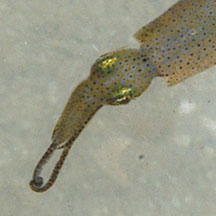 Squids have a pair of onger tentacles that extend beyond the shorter arms. Pulau Hantu, Aug 03 |
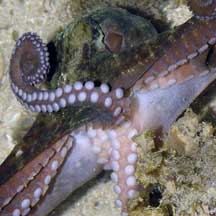 Underside of the octopus is full of suckers. Sisters Island, May 07 |
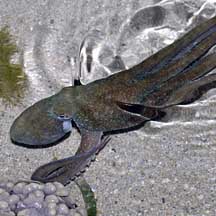 An octopus using jet propulsion to move. Cyrene Reef, Oct 08 |
| Arms vs tentacles: All cephalopods
have 8 arms. In addition to these arms, squids and cuttlefish have
a pair of tentacles. Tentacles have suckers only at the tips (arms
have suckers throughout the length) and the tentacles are used in
a special way. More details on the page about squids
and cuttlefish. Jet-powered Molluscs: Cephalopods can zoom about quickly with jet-propulsion. They forcefully squeeze water out of their mantle cavity (a cavity in their body) through a flexible funnel and shoot off in the opposite direction. The funnel can be pointed in different directions to control their movement. Squids and cuttlefishes also have fins along their bodies to control swimming movement. |
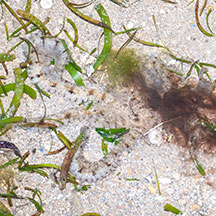 Octopus is perfectly camouflaged with the sand, while its distracting ink trails away. Cyrene, Mar 12 |
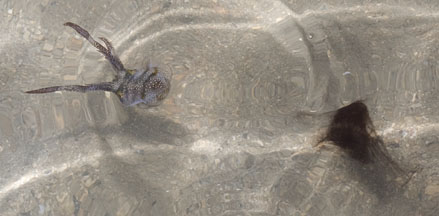 The ink squirted out by this squid retains its shape. Sister Island, May 12 |
| Disappearing Ink: Many octopuses, squid and cuttlefish can squirt ink that distracts predators and clouds up the water. The ink might be combined with mucus to form an ink-blot that holds its shape for a while in the water. This ink-blot decoy distracts the predator while the cephalopod makes its escape. The ink may also contain substances that affect the senses of other sea creatures. The ink contains melanin, the same pigment that colours our skin. It is produced in a special gland embedded in the liver. Another organ produces the mucus to mix with the pigment. Jets of water from the funnel direct and shape the pigment and mucus into a shape that suits the cephalopod's purposes. |
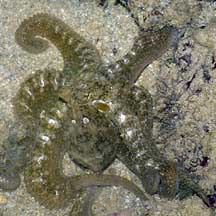 These two photos are of the same animal .. Sentosa, Jul 04 |
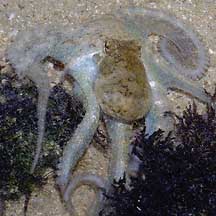 ... taken minutes apart. |
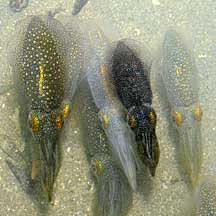 Squids taking on different colours. Tanah Merah, Jun 09 |
| Colourful Cephalopods: Octopuses,
squids and cuttlefishes have complex skin that can instantly change
colour. Octopuses and cuttlefishes can also change the texture of
their skin, creating bumps, flaps, fingers and other projections to
match their surroundings. Many squids are also bioluminescent. The rapid colour and pattern changes are achieved by controlling chromatophores, groups of cells that contain pigments which the animal can rapidly change in size and shape. Beneath the chromatophores are iridophores, layers of platelets made of chitin or proteins which produce the metallic green, blue, gold and silver colours by reflecting light. Iridophores are found in cuttlefish, some squids and some octopuses. Social Cephalopods: Cephalopods have relatively well-developed behaviour for interacting with each other. This involves colours changes and postures during courtship, mating and territorial disputes. |
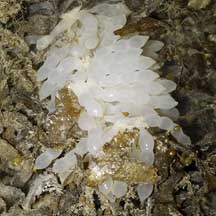 Cephalopod egg capsules commonly seen. Pulau Hantu, Feb 08 |
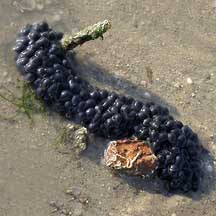 String of black cephalopod egg capsoules Changi, Jul 02 |
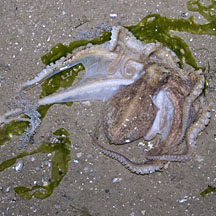 Octopus carrying egg string along. Changi, Jul 09 |
| Cephalopod Babies: Cephalopods
have separate genders and practice internal fertilisation. The male
usually has some sort of modified arm to insert his sperm packet into
the female. She later uses the sperm to fertlise her eggs which are
usually laid in capsules or cases.
These do not hatch into free-swimming larvae but into miniatures of
the adults. However, some of these tiny juveniles might drift with
the plankton for a while. Most cephalopods don't live long; about
1-2 years, dying soon after they reproduce. Human uses: People everywhere enjoy eating cephalopods. Cephalopods are also much studied for a better understanding of human anatomy. Status and threats: None of our cephalopods are listed among the threatened animals of Singapore. However, like other marine creatures, molluscs are vulnerable to habitat loss due to reclamation or human activities along the coast that pollute the water. They are also vulnerable to trampling by careless visitors and over-collection for food can affect local populations. |
|
Cephalopods recorded for Singapore |
Links
|