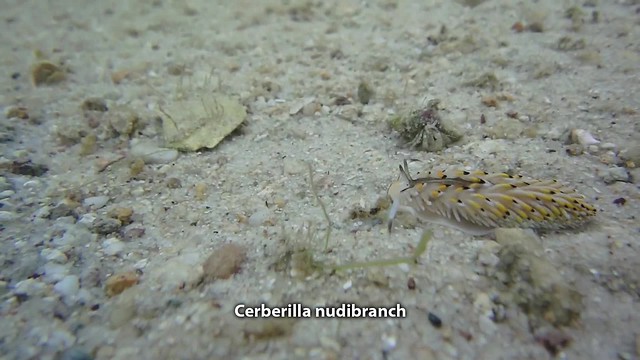
Cerberilla
nudibranch
Cerberilla sp.
Family
Aeolidiidae
updated
May 2020
Where
seen? This tiny 'furry' nudibranch is sometimes seen among Sea
Lettuce (Ulva sp.) as well as burrowing in sandy areas
on our Northern shores.
Features: 1-2cm long. Broad,
soft body with many long finger-like extensions (called cerata) arranged
in rows. The colour in the cerata is actually in the digestive glands.
The rhinophores at the top of the head are very short compared to
the long oral tentacles, the long tentacles that stick out on the
sides like a moustache. The oral tentacles have a black stripe that
runs across the front of the 'face' too. Young nudibranchs have longer
oral tentacles relative to their body size. The foot is quite broad. |
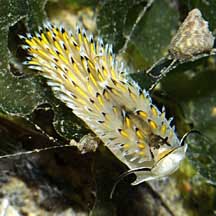 Pasir Ris,
Dec 08
Pasir Ris,
Dec 08 |
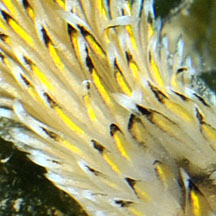 Yellow colour
is inside, and are
Yellow colour
is inside, and are
the digestive glands in the cerata. |
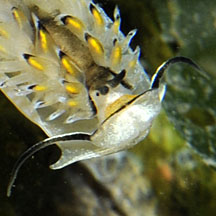 Long oral tentacles
and short rhinophores.
Long oral tentacles
and short rhinophores. |
What does it eat? It is believed
to feed on sea
anemones.
Cerberilla nudibranchs produce a spiral egg mass with a long string
or thread at the end that is attached to something hard in the sand
and thus anchor the eggs in the sand.
The more commonly seen ones with cerata tipped in yellow, black and
white is probably Cerberilla asamusiensis. But other kinds
of Cerberilla nudibranchs have also been seen on our shores. |
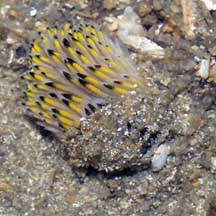 Burrowing into
the ground.
Burrowing into
the ground.
Pulau Sekudu, Jun 06 |
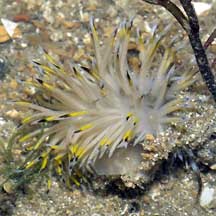 Cerata 'bristling'
when disturbed.
Cerata 'bristling'
when disturbed.
Pulau Sekudu, Jun 06 |
Yellow colour
is inside, and are
the digestive glands in the cerata.
|
| Cerberilla
nudibranchs on Singapore shores |
| Other sightings on Singapore shores |
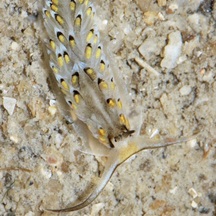
Changi, May 12
Photo shared by James Koh on his
blog. |
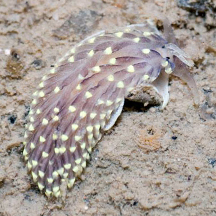
Changi, May 14
Photo shared by Heng Pei Yan on facebook. |
|
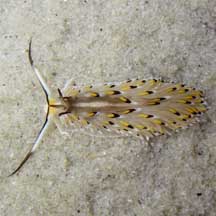 Chek Jawa,
Jul 08
Photo shared by Toh Chay Hoon on her
flickr.
Chek Jawa,
Jul 08
Photo shared by Toh Chay Hoon on her
flickr. |
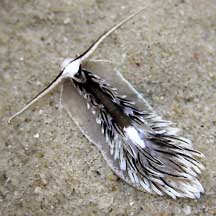 Chek Jawa,
Feb 02
Chek Jawa,
Feb 02 |
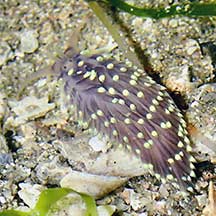 Chek Jawa,
Jun 21
Photo shared by Toh Chay Hoon on facebook.
Chek Jawa,
Jun 21
Photo shared by Toh Chay Hoon on facebook. |
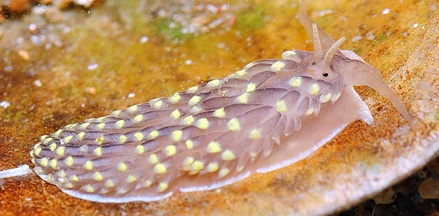
Pulau Sekudu, Oct 11
Photo
shared by Loh Kok Sheng on his
blog. |
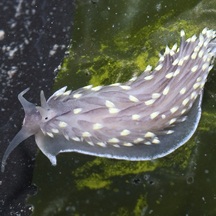 Pasir Ris,
Jul 12
Pasir Ris,
Jul 12 |
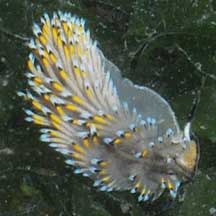
Pulau Sekudu, Apr 09
Photo shared by Toh Chay Hoon on her
blog. |
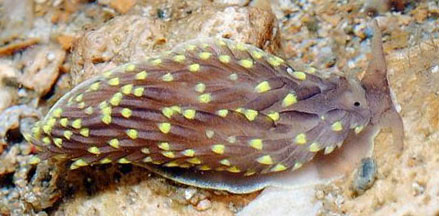
Pulau Sekudu, Jun 14
Photo
shared by Loh Kok Sheng on flickr. |
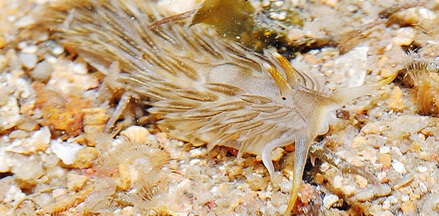
Pulau Sekudu, Oct 11
Photo
shared by Loh Kok Sheng on his
blog. |
|
|
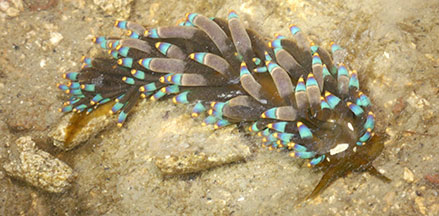
Beting Bronok, Jul 19
Photo
shared by Abel Yeo on facebook. |
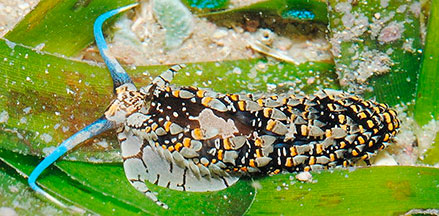 Cyrene Reef,
May 11
Cyrene Reef,
May 11
Photo shared by Loh Kok Sheng on flickr.
|
|
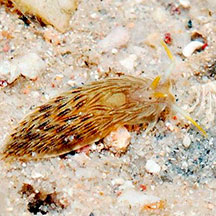 Cyrene Reef,
Aug 12
Cyrene Reef,
Aug 12
Photo shared by Loh Kok Sheng on flickr. |
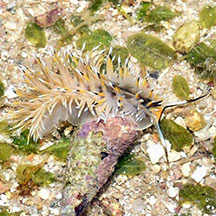 Cyrene Reef,
Aug 17
Cyrene Reef,
Aug 17
Photo shared by Loh Kok Sheng on facebook. |
|
Links
References
- Tan Siong
Kiat and Henrietta P. M. Woo, 2010 Preliminary
Checklist of The Molluscs of Singapore (pdf), Raffles
Museum of Biodiversity Research, National University of Singapore.
- Debelius,
Helmut, 2001. Nudibranchs
and Sea Snails: Indo-Pacific Field Guide
IKAN-Unterwasserachiv, Frankfurt. 321 pp.
- Coleman,
Neville. 2001. 1001
Nudibranchs: Catalogue of Indo-Pacific Sea Slugs. Neville
Coleman's Underwater Geographic Pty Ltd, Australia.144pp.
- Coleman,
Neville, 1989. Nudibranchs
of the South Pacific Vol 1. 64 pp.
- Humann, Paul
and Ned Deloach. 2010. Reef
Creature Identification: Tropical Pacific New World Publications.
497pp.
- Gosliner,
Terrence M., David W. Behrens and Gary C. Williams. 1996. Coral
Reef Animals of the Indo-Pacific: Animal life from Africa to Hawaii
exclusive of the vertebrates
Sea Challengers. 314pp.
|
|
|