 |
|
|
Tendril
slug
Lobiger viridis
Family Oxynoidae
updated
Jun 2020
Where
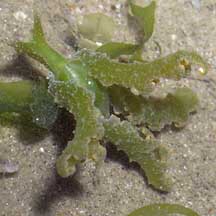
seen? This well camouflaged slug is sometimes seen among green seaweeds on our Northern and Southern shores.
Features: To about
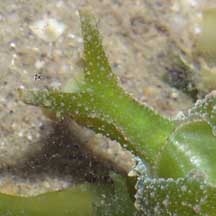
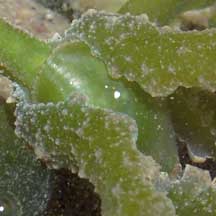
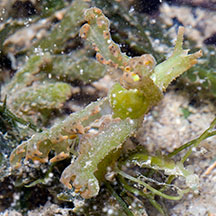
3cm. It has a green shell and four long 'fingers' sticking out of
the sides of its body that look like tendrils of a seaweed. These
tendrils can be 'rolled up', making the slug very difficult to see
among round seagrape seaweeds, for example.
The tendrils can also be suddenly expanded and unfurled. This may be done to deter predators.
The tendrils can also be dropped off (autotomized) whereupon the tendril
continues to wriggle and thus distract the predator. Colour mostly green to match the seaweeds it is found on. Often with orange edges to its tendrils.
What
does it eat? Reports find this slug often among Oval
sea grape seaweeds (Caulerpa racemosa). The tendrils
may also help the slug obtain food from photosynthesis. Like
other sacoglossans, this slug retains in its body, the chloroplasts
obtained from its seaweed food. |
Changi, Jun 05 |
|
|
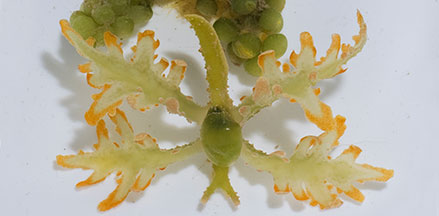
Tendrils can be suddenly unfurled to deter predators.
Pulau Tekukor, Apr 13 |
|
| Tendril
slugs on Singapore shores |
| Other sightings on Singapore shores |
Changi East, Dec 12
Photo shared by Marcus Ng on flickr. |
|
|
Links
References
- K. R. Jensen. Sacoglossa (Mollusca: Gastropoda: Heterobranchia) from northern coasts of Singapore. 10 July 2015. The Comprehensive Marine Biodiversity Survey: Johor Straits International Workshop (2012) The Raffles Bulletin of Zoology 2015 Supplement No. 31, Pp. 226-249.
- K. R. Jensen & R. S. L. Ong. Spawning observed in a specimen of the shelled sacoglossan Lobiger viridis Pease, 1863 from Singapore (Mollusca: Gastropoda: Heterobranchia).10 July 2015. The Comprehensive Marine Biodiversity Survey: Johor Straits International Workshop (2012) The Raffles Bulletin of Zoology 2015 Supplement No. 31, Pp. 250-254..
- Debelius,
Helmut, 2001. Nudibranchs
and Sea Snails: Indo-Pacific Field Guide
 IKAN-Unterwasserachiv, Frankfurt. 321 pp.
- Wells, Fred
E. and Clayton W. Bryce. 2000. Slugs
of Western Australia: A guide to the species from the Indian to
West Pacific Oceans.
Western Australian Museum. 184 pp.
- Coleman,
Neville. 2001. 1001
Nudibranchs: Catalogue of Indo-Pacific Sea Slugs. Neville
Coleman's Underwater Geographic Pty Ltd, Australia.144pp.
- Coleman,
Neville, 1989. Nudibranchs
of the South Pacific Vol 1. 64 pp.
- Humann, Paul
and Ned Deloach. 2010. Reef
Creature Identification: Tropical Pacific New World Publications.
497pp.
- Kuiter, Rudie
H and Helmut Debelius. 2009. World
Atlas of Marine Fauna
 . IKAN-Unterwasserachiv. 723pp.
- Gosliner,
Terrence M., David W. Behrens and Gary C. Williams. 1996. Coral
Reef Animals of the Indo-Pacific: Animal life from Africa to Hawaii
exclusive of the vertebrates
Sea Challengers. 314pp.
|
|
|