 EXPLORE•EXPRESS•ACT! |
| What
is ecological footprint?
"The simplest way to define ecological footprint would be to call it the impact of human activities measured in terms of the area of biologically productive land and water required to produce the goods consumed and to assimilate the wastes generated. More simply, it is the amount of the environment necessary to produce the goods and services necessary to support a particular lifestyle." from the WWF website. What is YOUR ecological footprint? Here's one ecological footprint calculator. Although it is based on UK data, it does give an approximation of the impact of your lifestyle choices. At the end of it, get the (often shocking) results in terms of "If everyone lived like you, we would need (x number of) planet earths" |
| What
is Singapore's ecological footprint? This is the graph from the 2014 WWF Living Planet Report which shows Singapore (in red circle) among the top countries with a huge ecological footprint, well exceeding the world average (in red text) 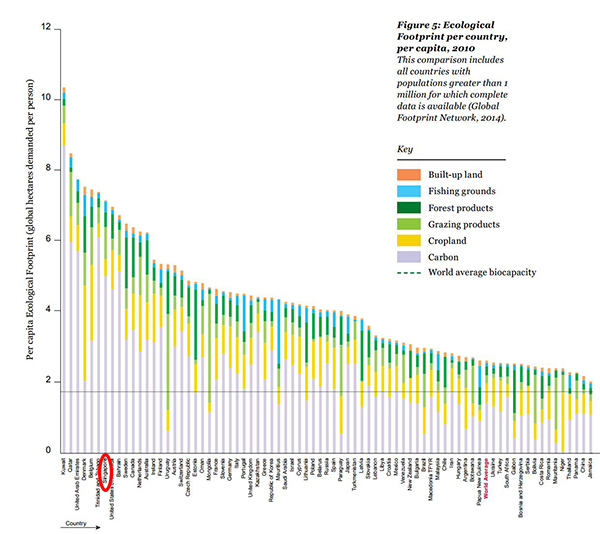 |
| What
is ecological footprint? From Sustainability Illustrated |