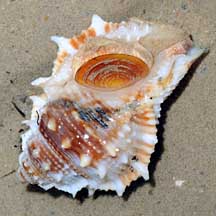
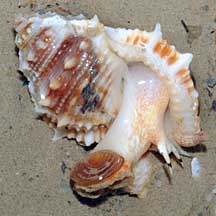
Frog
snail
Bufonaria sp.
Family Bursidae
updated
Oct 2019
Where
seen? Although the shells are often seen (usually occupied
by hermit crabs), living snails are rarely seen. Usually at the lowest
tides near seagrass meadows on our Northern and Eastern shores. Apparently,
the name is due to the warty texture of the shell.
Features: 4-6cm. Shell thick,
conical with spirals of many regular bumps and blunt spines. There
is a short tubular tip on the shell for the siphon. Ooperculum thin
and flexible, made of a horn-like material. Body pale, with a long
muscular foot, short tentacles with a black band at the tips.
The Common frog snail (Bufonaria rana) is about 7.5cm long,
up to 9cm and found on mud or muddy-sand bottoms.
What does it eat? Some species
appear appear to feed on tube worms. These have an extendible proboscis
and large salivary glands, that are probably used to anaesthetize
the worms in their tubes; the worms are then sucked out and swallowed
whole.
|
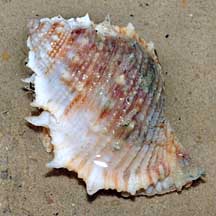
East Coast, Nov 08 |
|
|
|
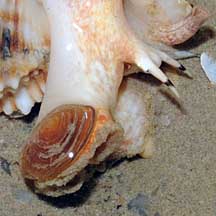
Muscular foot with operculum. |
|
| Frog
snails on Singapore shores |
| Other sightings on Singapore shores |
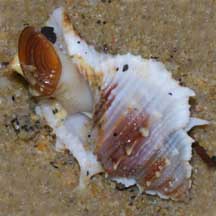
East Coast, Jul 09
Photo shared by Loh Kok Sheng on his
blog. |
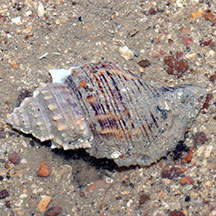
Beting Bronok, Jun 18
Photo shared by Loh Kok Sheng on facebook. |
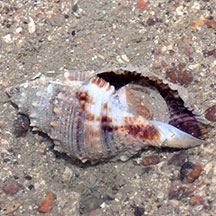
Beting Bronok, Jun 18
Photo shared by Loh Kok Sheng on facebook. |
Family
Bursidae recorded for Singapore
from
Tan Siong Kiat and Henrietta P. M. Woo, 2010 Preliminary Checklist
of The Molluscs of Singapore.
| |
Bufonaria
perelegans
Bufonaria rana=Bursa rana |
|
| Links
References
- Tan Siong
Kiat and Henrietta P. M. Woo, 2010 Preliminary
Checklist of The Molluscs of Singapore (pdf), Raffles
Museum of Biodiversity Research, National University of Singapore.
- Tan, K. S.
& L. M. Chou, 2000. A
Guide to the Common Seashells of Singapore. Singapore
Science Centre. 160 pp.
- Wee Y.C.
and Peter K. L. Ng. 1994. A First Look at Biodiversity in Singapore.
National Council on the Environment. 163pp.
- Abbott, R.
Tucker, 1991. Seashells
of South East Asia.
Graham Brash, Singapore. 145 pp.
|
|
|