Fig
snail
Ficus variegata
Family Ficidae
updated
Jul 2020
Where seen? These snails are not commonly encountered.
Mainly on wide clean sandy shores that are rich in buried marine life.
They are usually more active at night. At low tide they are usually
buried in the sand and only emerge at high tide.
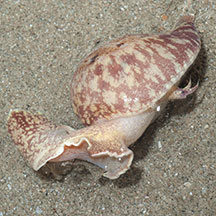
Features: 8-10cm long. The thin
but strong shell is shaped like a fig, bulbous with a very short spire and
large shell opening. Shell pattern usually white spirals with dark irregular bars over a speckled brown background. Mantle fleshy mottled often enclosing the entire shell.
The snail has a large head with two long tentacles,
a very long proboscis, and a long siphon. Large strong foot. It does not have an operculum
an adult. |
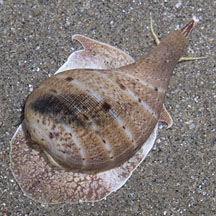
Changi, Oct 11 |
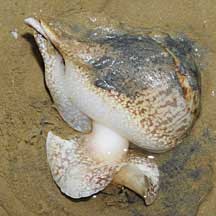
East Coast, Dec 08 |
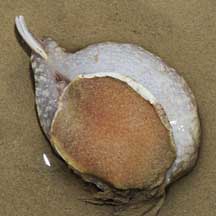
East Coast, Dec 08 |
| What do they eat? From Mei Lin's study, their prey is unknown.
Their teeth and feeding structures suggest they don't eat large prey.
Remains of worms have been seen in some species of fig snails. According to Poutiers, they eat sea urchins and other echninoderms.
But there have been no actual observations of them doing so. |
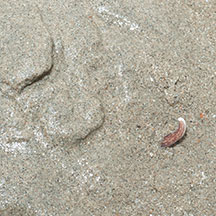
Buried with only its siphon sticking out.
Changi East, Dec 12 |
Changi East, Dec 12 |
|
| Fig
snails on Singapore shores |
| Other sightings on Singapore shores |
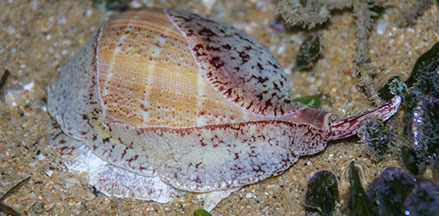
East Coast Park, Jun 20
Photo shared by Jonathan Tan on facebook. |
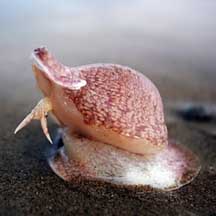
East Coast Park, Jan 10
Photo shared by Liana Tang on her
blog.
|
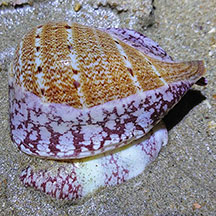
East Coast Park, Jul 20
Photo shared by Richard Kuah on facebook. |
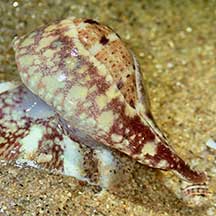
East Coast Park (G), May 21
Photo shared by Toh Chay Hoon on facebook. |
|
Family
Ficidae recorded for Singapore
from
Tan Siong Kiat and Henrietta P. M. Woo, 2010 Preliminary Checklist
of The Molluscs of Singapore.
| |
Ficus
ficus
Ficus variegata |
|
| Links
References
- Tan Siong
Kiat and Henrietta P. M. Woo, 2010 Preliminary
Checklist of The Molluscs of Singapore (pdf), Raffles
Museum of Biodiversity Research, National University of Singapore.
- Neo, M. L.,
2010. The taxonomic status of fig shells, with notes on Ficus
variegata (Roding, 1798) (Mollusca: Gastropoda: Ficoidea:
Ficidae). Nature
in Singapore, 3: 117-123.
- Abbott, R.
Tucker, 1991. Seashells
of South East Asia.
Graham Brash, Singapore. 145 pp.
|
|
|