 |
|
|
Worm
snails
Family Vermetidae
updated
Oct 2016
if you
learn only 3 things about them ...
 Although they look like worms, they are actually snails! Although they look like worms, they are actually snails!
They filter feed at high tide, gathering bits with a 'net'.
Look
for them on large boulders and other hard surfaces. |
|
Where
seen? These odd-looking snails are seen coiled on rocks,
stones and other hard surfaces. Commonly seen on our Northern shores.
Often, the snail shell is covered with encrusting lifeforms, so only the shell opening is visible. Some snails of the Family
Turritellidae also build coiling shells.
Features: Tube opening 1-2cm in
diameter, coils 10cm long or more. This amazing snail is NOT a worm.
It builds a thin hard tube on hard surfaces. The worm snail has a
pair of short thick tentacles, and a short foot. Some species of worm
snails have a thin operculum attached to the foot that is used to
seal the shell opening, others don't. As young snails, the shell they
produce appears 'normal', and are free-living and unattached. But
they soon attach to a hard surface and the shell produced becomes
meandering and coiling. |
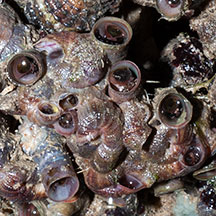
Pulau Sekudu, Jul 13
|
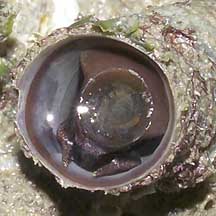
Changi, Apr 05 |
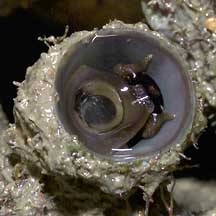
Tuas, May 05 |
| Sometimes confused with keelworms (Phylum Annelida, Class Polychaeta) which are segmented worms that
also build coiling hard shells on hard surfaces. Tubes made by worms
such as keelworms are dull on the inside and made up of two layers.
Tube worms have segmented bodies. Tubes made by snails such as vermetids
are glossy on the inside because of a deposit of nacre, and made up
of three layers. Vermetid snails do not have segmented bodies. Here's
more on how to tell apart animals
that make hard coiling tubes. |
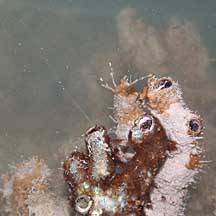
Feeding with mucus strands?
Raffles Marina, Jun 02 |
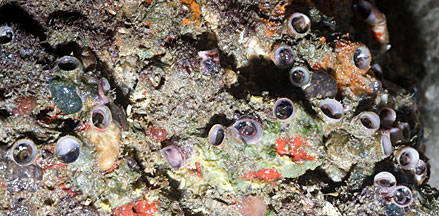
Often, the shell is covered in encrusting lifeforms and only the shell opening is seen.
Punggol, Jun 12 |
What does it eat? A worm snail
'nets' food from the water. A sticky mucus net is secreted from a
gland near the foot. This net can extend many times the body length.
Elsewhere, it was observed that a vermetid snail with a tube diameter
of 5cm had a mucus net 2m long! The animal gathers the mucus and eats
it together with whatever tasty bits are stuck on it. The vermetid
snail's digestive system is more similar to that of bivalves than
other gastropods.
Worm snail babies: Male worm snails
release their sperm in packets. Female worm snails 'net' these sperm
packets in the same way that they gather food. As the sperm packets
are hauled near the female's body, the sperm is released from the
packet. Or the female may store the sperm to fertilise the eggs later.
Eggs are retained inside the tube. They don't have a free-swimming
stage and emerge out of the tube as little snails. After crawling
about briefly, they cement themselves to a hard surface.
Human uses: In Polynesia, they
are a traditional food of some coastal people. |
| Vermetid
snails on Singapore shores |
| Other sightings on Singapore shores |
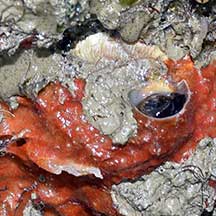
Pasir Ris-Loyang, Oct 20
Photo
shared by Loh Kok Sheng on facebook. |
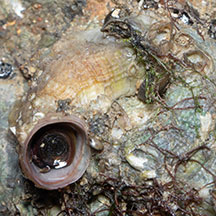
Pasir Ris Park, Dec 25
Photo shared by Yan Le Su on facebook. |
|
Family
Vermetidae recorded for Singapore
from
Tan Siong Kiat and Henrietta P. M. Woo, 2010 Preliminary Checklist
of The Molluscs of Singapore.
^from WORMS
| |
Serpulorbis
sp.=^Thylacodes sp.
Vermetus sp. |
|
Links
References
- Tan Siong
Kiat and Henrietta P. M. Woo, 2010 Preliminary
Checklist of The Molluscs of Singapore (pdf), Raffles
Museum of Biodiversity Research, National University of Singapore.
- Tan, K.
S. & L. M. Chou, 2000. A
Guide to the Common Seashells of Singapore. Singapore
Science Centre. 160 pp.
|
|
|